AI helpdesk solutions play a vital role in today's workplace. Gartner's data shows AI adoption in HR has surged from 19% in 2023 to 61% in 2025. Many organizations feel frustrated when their investments don't yield the expected outcomes.
The challenge lies not with the technology but with a core limitation: context. Traditional ai help desk software handles basic, standalone requests well. However, it doesn't deal very well with complex, multi-step interactions that need memory and understanding. The economic possibilities are significant—agentic AI could generate up to $450 billion in value by 2028. Yet many current ai helpdesk systems fail to deliver on their promise.
Organizations face this reality every day. Their employees use "smart" systems that keep asking for identical information and forget past conversations. These interactions often lead to human agent escalations. Rather than boosting efficiency, this creates frustration. A well-implemented system can cut ticket volumes by 70% and speed up resolution times by 30-50%.
Let's examine why traditional AI helpdesks fall short, how the missing context problem shows up, and the way agentic AI—a new approach that functions as a self-driven digital problem solver—can revolutionize employee experiences while delivering concrete business outcomes.
Why Traditional AI Helpdesk Solutions Fall Short
Traditional AI helpdesk solutions promise efficiency and automation but rarely deliver in ground applications. A deeper look shows several basic limitations that stop these systems from reaching their full potential.
Lack of contextual memory in AI helpdesk software
The "context window" remains a major constraint in most AI helpdesk implementations. This fixed-size buffer holds the current conversation. Once exceeded, older information gets pushed out and the AI forgets earlier parts of the interaction. AI systems have data but lack deeper meaning or relationships. This creates what experts call a "why context gap".
This memory problem shows up in three ways:
- Long-term memory issues: AI helpdesks can't retain information across extended interactions without special engineering. Each session starts fresh and abandons previous learnings.
- Knowledge retention failure: Studies show that 75% of chatbots don't use persistent memory, yet 69% of customers expect businesses to remember past interactions.
- Context erosion: The model answers the wrong question or gives a generic response when key details aren't in the current query because it lacks awareness of relevant context.
This memory problem creates a cycle where employees must provide the same information repeatedly. Research shows employees rate their experience 82% worse when they must repeat technical information compared to smooth interactions.
Over-reliance on static workflows and scripts
Helpdesk systems have relied on structured workflows, scripted responses, and rigid escalation paths for years. These models create consistency but fail when faced with complex employee interactions.
Problems become clear in complex scenarios through what experts call "combinatorial explosion." Total possible paths grow exponentially as K^N for a system with N decision points and K average branches per decision. Here's a practical example:
- A lead scoring workflow needs nearly 5,000 pre-defined rules to handle all combinations when thinking about company size (5 categories), industry (10 types), engagement level (4 stages), tech stack (8 categories), and market timing (3 phases).
Employees must change their communication style to fit the system's rigid structure with static workflows. This creates unnecessary friction. These workflows also struggle with subtle, targeted scenarios. Even with 99% coverage, important edge cases slip through.
Failure to handle multi-step employee requests
Traditional AI helpdesks break down when facing complex, multi-step requests. Password reset loops, onboarding workflows with cross-department dependencies, and payroll queries that need historical data create particular challenges.
Technical reasons for these failures include:
- Ambiguity resolution: AI proceeds with its best guess when it finds multiple valid interpretations instead of pausing to clarify.
- Error recovery limitations: AI helpdesks either stop completely or continue with corrupted state unlike humans who naturally try different approaches.
- State management issues: Traditional AI struggles to manage evolving information as each step's outputs become inputs for later steps.
This inability to handle complexity shows in the numbers: 48% of users report that chatbot technology fails to resolve issues or understand user intent, while 61% experience failures in intent recognition.
Employee experience suffers greatly. Studies show the Mean Time to Resolution for HR requests increased from 6.18 to 9.72 hours since the pandemic, yet 46% of employees believe HR should respond to routine questions the same day. Employee satisfaction drops by 35% on average when they wait more than 8 hours for an initial response.
Traditional AI helpdesks end up creating more problems than they solve. They force employees into frustrating cycles of repetition, clarification, and human escalation.
Understanding the Missing Context Problem
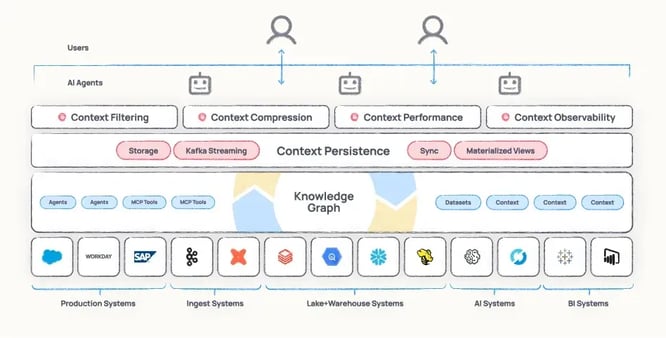
Image Source: DataHub
Context forms the foundation of effective AI helpdesk interactions. This vital element often goes missing in standard implementations and undermines the employee's support experience.
What 'context' means in AI helpdesk interactions
AI systems need context to work - it covers all background information that gives meaning to user interactions. Two simple types exist: user context (personal and historical data) and ecosystem context (external factors and live information). AI helpdesk solutions use this information to understand employee needs and provide relevant responses.
The difference between powerful AI models like ChatGPT and underperforming AI helpdesk software isn't about core AI capabilities. The real issue lies in whether the AI can access complete information about the employee it tries to help.
This "missing context problem" shows up when:
- An AI helpdesk sends a high-value employee to simple support despite their VIP status
- Support tickets go to wrong teams because the AI doesn't know about related open cases
- AI-generated responses mention features an employee can't access
- Support systems don't recognize when an employee has canceled services or has payment issues
One expert notes, "The AI isn't failing because it's not sophisticated enough. It's failing because your data infrastructure doesn't give it the information it needs". Even sophisticated AI helpdesk solutions make seemingly reasonable decisions that end up being wrong because they lack proper context.
Session continuity and memory limitations
Memory constraints severely limit AI helpdesk systems. They use a fixed context window - a limited buffer of information they can reference during interactions. Older information gets pushed out once exceeded, and the system forgets earlier parts of the conversation.
A fundamental continuity gap exists: AI helpdesks work well within a tight conversational window but lack reliable persistence across time, devices, or systems. These systems start each session fresh without special engineering. They forget previous learnings and force employees to provide the same information repeatedly.
The root cause lies in how AI APIs are designed - they follow "stateless" principles where each interaction stands alone. This works for simple, one-off requests but falls apart during complex, multi-step employee interactions that need consistent memory.
Claude's API, like other leading AI platforms, keeps no persistent memory between sessions. Developers try to fix this by adding longer "continuation prompts," but these become messy quickly and still miss key context.
Impact on employee experience and resolution rates
Missing context has a big effect on employee experience. AI helpdesk systems create frustrating cycles of repeated information requests and irrelevant solutions without contextual awareness. Each department's system contains a piece of the complete employee picture - useful on its own but inadequate for complete support.
Employees might spend over 20 minutes explaining situations again to a fresh chat session after hitting context limits when debugging workflow issues. This defeats the purpose of AI's efficiency.
More problems arise without effective context handling:
- Technical insights vanish between sessions instead of becoming institutional knowledge
- Session startup times take longer (20+ minutes versus under 5 minutes with proper context management)
- Personalization gets misaligned based on correlation rather than stated intent
The context problem turns what should be a smooth experience into a fragmented trip filled with repeated explanations and frustrations. The biggest issue occurs when AI helpdesks make decisions using partial information to route tickets, suggest responses, or escalate issues.
Building more sophisticated AI models won't fix this - the real solution lies in fixing the data architecture that prevents contextual understanding. One expert concludes, "Context management isn't overhead—it's a core engineering practice, like version control or testing".
Common Scenarios Where Context Breaks Down
AI helpdesk solutions often fail at specific points when they can't manage context properly. The problems employees face show us how theoretical limits turn into real frustrations.
Password reset loops and repeated identity checks
Password resets make up the bulk of helpdesk tickets in most companies. These simple-looking requests show the basic problems that current AI help desk software faces.
The numbers tell a clear story. Each manual password reset costs companies between ₹1,265 and ₹5,906 in labor, time, and lost work. Big companies spend nearly ₹80 lakh (about $1 million) every year just to help people reset their passwords.
The process creates endless loops that drive employees crazy:
- An employee gets locked out of their account
- They contact the AI helpdesk to reset their password
- The system requires identity verification
- A temporary password is issued
- The employee must change this temporary password
- Any new issues make the whole process start over
The AI helpdesk's lack of memory means it can't remember that an employee just proved who they are. Users end up stuck in an endless loop of proving their identity - even in the same conversation.
Onboarding workflows with cross-department dependencies
Employee onboarding shows how complex processes need ongoing context across multiple departments. The process needs HR, legal, IT, and facilities teams to work together in a specific order.
These problems show up in several ways:
Hiring managers waste time with long forms that collect wrong information. Rule-based sorting slows down request processing. Legal teams spend too much time reviewing documents. IT gives out generic equipment that doesn't fit specific needs. The facilities teams can't plan space properly.
The results speak for themselves. 48% of new hires say they don't get enough training after onboarding, and almost 30% look for new jobs within three months. Companies with poor onboarding lose 16% of new hires in six months.
Remote workers have it worse. About 36% find onboarding confusing compared to 32% of on-site employees. These numbers show just how much context matters in these processes.
Leave and payroll queries requiring historical data
Most AI helpdesk systems can't handle the extensive historical data needed for payroll and leave management questions. Employees ask about old payslips, leave balances, and policy changes over time.
These simple-looking questions overwhelm basic AI systems. Workers need quick answers about their sick days, vacation time, and personal days to plan time off. AI helpdesks give outdated or generic answers when they can't understand context.
The same goes for payslip requests. The AI must track employee verification status and access rights. Employees end up proving their identity again and again for each document, even after sharing their ID numbers or birthdates.
Payce's CHIA AI chatbot shows what's possible with good context management. It handles over 50% of common HR questions with personal responses. Most other systems fall short because they can't maintain the right historical connections.
These examples show exactly where regular AI helpdesk systems break down - when they need to handle complex processes, historical data requirements, and work across departments.
How Agentic AI Solves the Context Gap
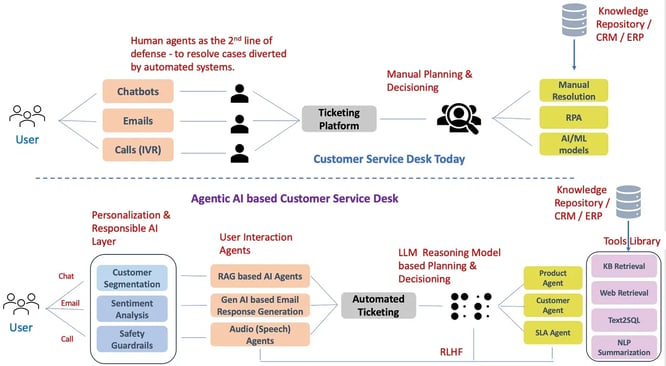
Image Source: Medium
Agentic AI changes how helpdesk systems work by solving the basic context limitations of older approaches. Traditional AI helpdesk solutions stick to rigid scripts, but Agentic AI works as an independent problem solver. It handles complex interactions while keeping track of context.
Multi-step reasoning and task orchestration
Agentic AI raises helpdesk capabilities through smart reasoning that breaks complex problems into manageable steps. This matches how humans think logically, with each step building on previous ones to solve problems. These systems process information differently. They don't give instant, single-step answers. Instead, they break down problems into smaller tasks while keeping track of the whole picture.
Task orchestration marks another big step forward. It brings multiple AI models and tools together in one framework. This arrangement creates better workflows by:
- Automating how various AI components work together
- Managing task dependencies to keep logical flow
- Fixing conflicts between different system parts
- Tracking progress toward solutions while maintaining context
This organized approach stops the fragmentation common in older systems. One system handles routine tasks like sorting tickets. Another finds needed information. A third manages escalation. They all work together to provide complete support.
Real-time data access across HRIS and ITSM systems
Agentic AI's second breakthrough comes from real-time data integration. AI help desk software without current data works like "a GPS running on last week's traffic updates—it leads you straight into a traffic jam".
Older approaches wait for scheduled updates. Agentic AI connects directly to live information from HRIS (Human Resource Information Systems) and ITSM (IT Service Management) platforms. Direct access removes the delay that holds back traditional AI's effectiveness.
Live integration makes things better by enabling:
- Better decisions based on current rather than old data
- Better operations with fewer errors and smarter resource use
- Better employee experience through personal attention based on current status
AI helpdesks can now work with full knowledge of an employee's history, status, and rights across departments.
Autonomous decision-making with human-in-the-loop fallback
Agentic AI's most powerful feature combines independent operation with human oversight. These systems run entire helpdesk processes on their own—from first question to final answer—without constant human input.
This independence shows through:
- Checking user information and finding issues
- Fixing errors and applying solutions
- Updating relevant systems automatically
All the same, Agentic AI systems keep human-in-the-loop (HITL) frameworks that add human judgment at key points. Unlike basic automation that runs alone until it fails, HITL creates teamwork between AI and humans. People step in when AI reaches its limits.
Confidence levels, sentiment analysis, and policy triggers determine when human expertise helps. To name just one example, when AI faces unclear terms or risky decisions, it smoothly connects to a specialist while sharing complete context and ideas.
Results prove this works—companies using structured HITL frameworks see 25-40% improvements in first contact resolution. Customer satisfaction scores go above 90%.
Real-World Examples of Context-Aware AI Helpdesks
Many innovative organizations have deployed context-aware AI helpdesk solutions with outstanding results. These ground examples show how good context management revolutionizes employee support experiences.
AMD's 80% reduction in HR resolution time
Advanced Micro Devices (AMD) teamed up with Kore.ai to revolutionize their global HR support operations while keeping the human touch intact. Their AI HR agent helped AMD achieve an 80% reduction in HR resolution time. The system delivered a 50% self-service deflection rate that cut routine requests needing human intervention by half.
The results were remarkable - AMD saw a 70% increase in employee satisfaction after deploying the AI helpdesk. This improvement shows that context-aware AI helpdesk solutions improve rather than reduce employee experience. AMD's achievements earned them Kore.ai's 'AI Business Impact' award for their innovative global AI deployment in human resources.
Rezolve.ai's Slack-based AI assistant for IT support
Rezolve.ai exemplifies contextual AI support that works directly within collaboration platforms where employees do their daily tasks. Their system combines smoothly with over 1,000 industry applications and enables complex process automation across organizations.
The platform revolutionizes support metrics by reducing first response times from hours to mere seconds through round-the-clock automated assistance. Its contextual capabilities include:
- Auto-resolving common issues like password resets and software provisioning
- Providing natural language processing to understand complex queries
- Maintaining conversation history within Slack for contextual awareness
Rezolve.ai expanded from Microsoft Teams to Slack, which extended contextual support across collaborative platforms. This eliminated the need for dedicated support agents to handle many routine requests.
Global bank's 94% ticket resolution via AI
A multinational banking and financial services company shows the powerful effect of context-aware AI in highly regulated environments. Their sophisticated AI ticketing system achieved an impressive 94% case classification accuracy.
The numbers tell a compelling story - the bank cut time-to-resolution by 30% and saved over $5 million in operational expenses. These improvements came from AI's ability to maintain context throughout complex cross-border payment exception handling.
A bank source explained: "Squirro's AI Predictions capability is essential for our service ticket routing workflows, while the system's self-learning capabilities are helping us keep our maintenance efforts at a low cost". Financial institutions that implement ticketless support consistently report 60-80% reductions in average handle time and 30-50% drops in call center volumes.
Best Practices to Build Context-Rich AI Helpdesk Systems
AI helpdesk solutions work best when they blend with existing systems, have well-planned workflows, and learn from past data. Companies should focus on building rich context environments instead of just adding new technology.
Integrating AI with existing HRIS and ITSM platforms
The foundation of good AI help desk software lies in connected, reliable data. Companies need to verify that their monitoring tools, CMDBs, and databases work well with ITSM platforms like ServiceNow, IBM, or Jira Service Management. Setting up APIs and connectors helps information flow smoothly between AI engines and ITSM systems. This creates a single stream of employee information and cuts manual work by 70% through shared data and automated routing.
Designing workflows for continuity and escalation
Good workflows put employees first, not technology. Many companies rush to implement AI without fixing their current problems. Here's what matters:
- AI should talk like humans through natural language processing
- Clear paths should lead to human support when AI hits its limits
- Confidence thresholds help decide when specialists add value
Context engineering treats context as its own system with unique architecture. This separates data storage from what the AI model actually sees.
Training AI on historical tickets and employee experiences
AI needs good training data before launch. This comes from past tickets with useful resolution notes that algorithms can learn from. Training must include key details like descriptions, timestamps, and resolution notes. Teams should test their AI against old tickets to check accuracy and success rates. A step-by-step rollout works best.
Conclusion
The success of AI helpdesk solutions depends on knowing how to keep context throughout employee interactions. AI technology advances faster each day, yet contextual understanding remains the key difference between frustrating experiences and truly game-changing support. The biggest problem isn't about using more sophisticated AI models. Companies should focus on the basic architecture that enables complete context management.
Companies that solve the context problem see dramatic improvements - 80% faster resolution times, 94% ticket classification accuracy, and millions saved in operational costs. Business leaders should treat context engineering as a core capability instead of an afterthought. This approach just needs careful integration with existing systems, thoughtful workflow design, and learning from past interactions.
On top of that, the change toward agentic AI marks an important rise in helpdesk technology. Traditional solutions were limited by static workflows and restricted memory. Now, agentic systems keep context across complex interactions while managing sophisticated multi-step processes. This capability turns a fragmented employee experience into a smooth trip.
Context-aware AI helpdesk systems will become standard across industries as organizations see their major effect on employee satisfaction and operational efficiency. All the same, successful implementation needs more than just technology - companies must rethink how information flows between systems and departments.
Of course, AI helpdesk solutions that succeed will keep the human touch while using contextual intelligence to solve complex problems. AI should improve, not replace, the human elements that make support work. With proper context management, organizations can tap into the full potential of AI helpdesks by giving employees smooth, efficient support that understands their unique needs and solves problems completely the first time.
Key Takeaways
Traditional AI helpdesk solutions fail primarily due to context limitations, not technological shortcomings. Here are the critical insights for building effective AI support systems:
• Context is the missing link: AI helpdesks struggle with memory limitations and lack of contextual awareness, forcing employees to repeat information and creating frustrating loops instead of seamless support experiences.
• Agentic AI transforms support through orchestration: Unlike static workflows, agentic AI maintains context across multi-step processes, accesses real-time data from HRIS/ITSM systems, and makes autonomous decisions with human oversight.
• Real-world results prove the impact: Organizations implementing context-aware AI achieve 80% faster resolution times, 94% ticket classification accuracy, and millions in operational savings while dramatically improving employee satisfaction.
• Integration strategy matters more than technology: Success requires thoughtful integration with existing systems, workflow design for continuity, and training AI on historical tickets rather than simply deploying advanced models.
• Human-in-the-loop ensures reliability: The most effective AI helpdesks combine autonomous capabilities with strategic human intervention at critical decision points, maintaining confidence thresholds and escalation paths for complex scenarios.
When implemented correctly, context-aware AI helpdesks transform employee support from a fragmented experience into a seamless journey that understands unique needs and resolves issues completely on the first interaction.
FAQs
Q1. Why do AI helpdesk solutions struggle with maintaining context? AI helpdesk solutions often have limited memory capacity, causing them to forget earlier parts of conversations. This leads to repetitive information requests and an inability to handle complex, multi-step interactions effectively.
Q2. What are the main challenges in implementing AI for customer service? Key challenges include the AI's lack of emotional intelligence, difficulty in handling complex queries, and potential for inappropriate responses. Without proper context management, AI can come across as cold or unhelpful, particularly in situations requiring empathy.
Q3. How does agentic AI improve helpdesk functionality? Agentic AI enhances helpdesk functionality through multi-step reasoning, real-time data access across systems, and autonomous decision-making with human oversight. This allows for more complex problem-solving and personalized support.
Q4. What results have organizations achieved with context-aware AI helpdesks? Organizations implementing context-aware AI helpdesks have reported significant improvements, including up to 80% reduction in resolution times, 94% ticket classification accuracy, and substantial operational cost savings, along with increased employee satisfaction.
Q5. What are best practices for building effective AI helpdesk systems? Key best practices include integrating AI with existing HRIS and ITSM platforms, designing workflows for continuity and escalation, and training AI on historical tickets and employee journeys. It's crucial to focus on creating context-rich environments rather than simply deploying new technology.
Trusted by 330+ CHROs
See why global HR teams rely on Amber to listen, act, and retain their best people.
