AI employee sentiment analysis that shows how people feel, and why
Read sentiment from check-in conversations with every employee, see which teams are slipping, and act before disengagement turns into exits.
“We’ve deployed Amber across 130,000 employees & those who engage with her are 2x likely to stay at Genpact. It is the only non-financial metric we have that drives the bonus pool for 200+ leaders at Genpact.
Meet Amber!
The Chief Experience Officer enterprises hire to talk to every employee, help them, and let leaders know who needs attention and why.
✨ BUILT ON 10 YEARS OF PEOPLE SCIENCE
EMPLOYEE SENTIMENT
Employee sentiment, read from every conversation
A survey score can show that engagement fell. It cannot show where, among whom or why. Amber reads every answer for all three, so HR fixes the cause instead of guessing at it.
Sentiment Analysis
See which topics pull sentiment down
Amber reads every answer for sentiment and rolls it up by question and by driver, a topic such as My Manager, so HR sees exactly which topics drag engagement down. Comments are summarised next to each score, so the numbers come with employees' own words.
Employee NPS
Track eNPS team by team
eNPS breaks down into promoters, passives and detractors by department, manager or location, with the trend over time. Amber asks the eNPS question in her conversation, so every score comes with its reasons.
Action Planning
Act on what detractors say
Amber drafts an action plan for the HRBP from each detractor's history and a best-practice library, and HR assigns an owner and a deadline. In a later chat, she asks the employee whether things improved.
Employer Brand
Turn promoters into public proof
When an employee rates their experience as good, Amber invites them to share it on Glassdoor or AmbitionBox, so the reviews candidates read come from real promoters.
How Amber reads employee sentiment

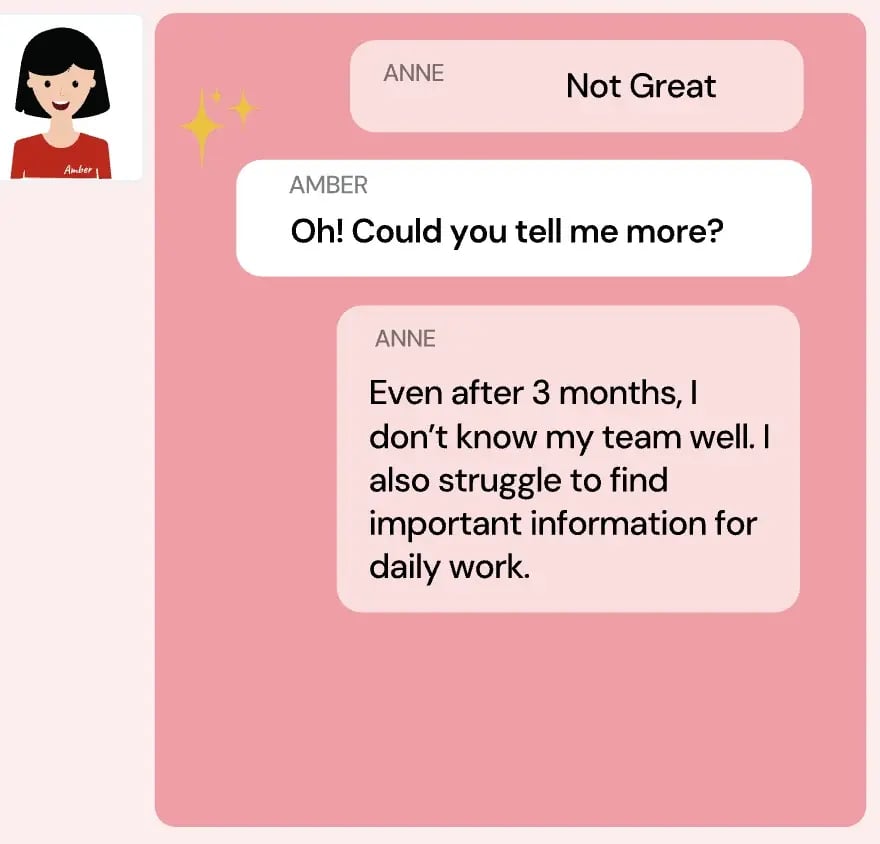
- Amber has the conversation. At milestones and in pulse surveys, she asks how each employee feels and follows up whenever an answer is negative.
- Amber reads every answer. She scores sentiment on each reply as it lands and summarises the comments into what is working and what needs attention.
- HR sees where, and why. Employee engagement analytics show sentiment by team, manager and location, in the dashboard, the weekly email, or Claude, ChatGPT, Microsoft Copilot or Gemini.
- HR acts, and Amber checks back. Employees who need attention go to the HRBP's People to Meet list with the reason attached. Later, Amber asks them whether things improved.
How inFeedo AI's sentiment analysis differs from other employee feedback tools
| Compared on | Typical employee feedback tool | inFeedo AI, with Amber |
|---|---|---|
| Where sentiment comes from | Survey scores and a comments box | A conversation with every employee, with a follow-up question on every negative answer |
| How often it updates | After each survey cycle | Continuously, as milestone check-ins and pulse surveys complete |
| What HR reads | Scores and raw comments | Sentiment by topic and question, with comments summarised |
| Who needs attention | An average for each team | Named employees, with the reason attached |
| Where leaders see it | A dashboard to log into | The dashboard, a weekly email and the AI assistant they already use |
| After HR acts | Nothing until the next survey | Amber asks each person whether things improved |
Delivering enterprise-grade security,
scale, and capabilities
SECURITY
GDPR and ISO compliant for data privacy
SCALE
Effortlessly manage your growing workforce
Global Presence
Deployed in 75+ countries with servers locally present in US, EU, India, Indonesia, etc.
Frequently Asked Questions
What is AI employee sentiment analysis?
AI employee sentiment analysis measures how positive or negative employees feel about each topic, from what they write in surveys, chats and comments, across the whole workforce. inFeedo AI scores each reply as it arrives in Amber's conversations, instead of waiting for a survey to close.
How can HR use AI to understand employee sentiment and engagement?
AI can read every open comment, group comments into themes and score how positive or negative each one is, at a scale no HR team can match. It helps most when the feedback itself comes from a conversation. At inFeedo AI, Amber holds a conversation with every employee, asks why when an answer is negative, and turns every reply into sentiment and engagement scores by team, manager and topic, with the reason attached.
What is eNPS, and how is it calculated?
Employee Net Promoter Score (eNPS) asks employees how likely they are to recommend their organisation as a place to work, on a scale of 0 to 10. Promoters answer 9 or 10, passives 7 or 8, and detractors 0 to 6. eNPS is the percentage of promoters minus the percentage of detractors, so it runs from -100 to 100. Amber asks the eNPS question inside her conversations, so each score comes with the employee's reasons.
Which employee feedback tools analyse sentiment in Slack, Microsoft Teams and WhatsApp?
Several employee feedback tools send survey links into chat apps and analyse the results afterwards. With inFeedo AI, Amber holds the conversation inside Microsoft Teams; on Slack, WhatsApp, Google Chat and email, she sends a link that opens the same chat. Either way, every answer is analysed for sentiment as it arrives, in any of 34 languages.
Is employee sentiment analysis confidential?
It depends on whether the tool collects feedback anonymously or confidentially. With inFeedo AI, Amber's conversations are confidential: a trust statement at the start of each chat names exactly who can read the answers, nearly every customer keeps the direct manager off that list, and reports hide groups too small to protect identity. For anything an employee will not put a name to, Anonymous Ally is a separate, anonymous channel.
How is sentiment analysis different from an engagement survey?
An engagement survey measures how engaged people are at one point in time. Sentiment analysis reads how people feel in what they say, as often as they say it. inFeedo AI does both from the same conversations, so HR gets the engagement score and the reasons behind it, by team and over time.