10 min read
Last Updated: 04 November 2025
AI benefits now play a significant role in business, as 80% of decision-makers believe AI adoption keeps their companies competitive. But organizations that quickly integrate AI technology throughout the employee lifecycle—from recruitment and onboarding to learning and development—often miss a vital component: human oversight.
By 2028, the global human-in-the-loop market will reach billions. This growth shows that AI systems need human guidance, especially in high-stakes environments. What good are AI systems if they can't understand context? This becomes even more important when we look at AI's role in HR, where decisions shape people's careers and livelihoods. Business leaders see clear benefits from generative AI, including time savings equal to a full-time employee. Yet organizations must balance these advantages against potential risks. This balance grows more important as new AI regulations emerge—including the EU AI Act, U.S. Executive Order 14110, and sector-specific guidelines—that require safeguards for automated systems.
This piece explores how Human-in-the-Loop AI adds the missing layer in HR automation. You'll learn why it matters and how it helps organizations handle both the amazing opportunities and possible pitfalls of AI-powered HR.
Why Fully Automated HR Systems Fall Short in High-Stakes Scenarios
AI tools automate many HR functions, but automated systems fall short when high-stakes scenarios need human judgment. These limitations become clear when you look at both technical and ethical aspects of AI-driven HR processes.
Lack of contextual understanding in AI-driven decisions
Automated HR systems work with logic and data but lack the emotional intelligence and contextual understanding that human HR professionals bring to complex workplace situations. AI systems process information based on set patterns, so they miss subtle contextual cues that HR professionals spot naturally. This weakness shows up during sensitive employee interactions where empathy and understanding are vital.
AI has trouble keeping up with the ever-changing world of regulatory compliance. Federal and state employment regulations change often, and AI systems need human help to stay current. On top of that, even the best AI platforms have "hallucination rates" as high as 27%—where models make up information instead of admitting they don't know.
The rigid nature of AI systems creates another basic problem. Traditional AI uses rule-based structures that don't work when faced with new scenarios. Unlike systems guided by humans, fully automated ones can't adapt without manual updates. This leads to big gaps in handling unique employee situations. This inflexibility shows up in several ways:
- AI can't pick up on subtle human behavior or specific employee circumstances
- Automated systems handle similar scenarios the same way, whatever the unique context
- AI doesn't have the moral compass needed to make ethical HR decisions
- Companies that rely too much on AI risk losing human skills like cultural fit assessment
Examples of automation failures in HR compliance and ethics
The risks of fully automated HR systems aren't just theory—several high-profile failures prove it. Amazon tried using an AI tool in 2014 to review job applications. The tool ended up downgrading women's CVs by penalizing resumes that had terms women commonly used. Amazon had to scrap the tool after finding this bias.
The EEOC's landmark case against iTutorGroup showed how AI hiring software broke the Age Discrimination in Employment Act by automatically rejecting older job applicants. iTutorGroup had to pay big compensation and change its hiring practices. This case highlights the legal risks of letting AI run unchecked.
Employee management has seen problems too. Uber faced legal action in 2021 after its algorithmic system unfairly fired six drivers for supposed fraud. The company had to hire them back and pay compensation exceeding €100,000. This whole ordeal proves that automation should help—not replace—human decision-making, especially when jobs are at stake.
System failures pose another serious risk. One notable case saw HR automation errors cause employee firings that nobody noticed until it was too late. These events don't just hurt employee trust—they shake faith in the entire HR automation project. As one industry expert said, "Trust once lost is hard to regain".
AI's role in HR needs careful balance between optimization and human oversight. Some tasks work well with automation, but we must weigh AI's benefits and risks against human judgment's irreplaceable value. This is especially true in high-stakes scenarios where compliance, ethics, and employee well-being matter most.
What is Human-in-the-Loop AI in the Context of HR Automation
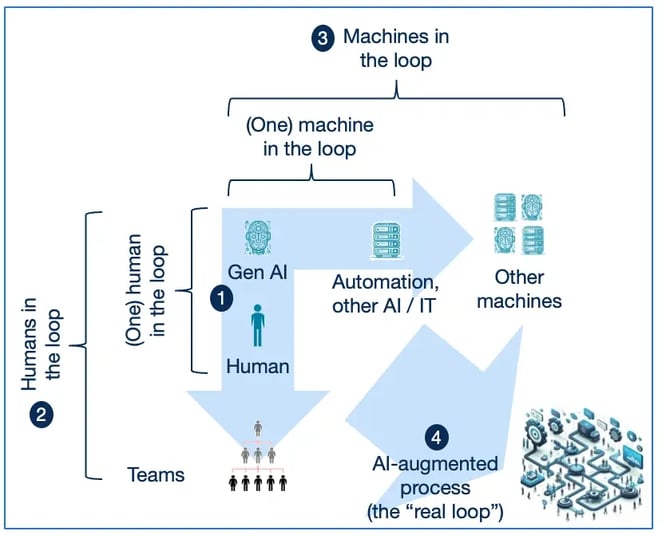
Image Source: LinkedIn
Human-in-the-Loop (HITL) AI makes shared work possible by adding human oversight to automated HR processes. This approach fixes many problems found in fully automated systems. HITL keeps humans as key players in AI decision-making instead of removing them completely.
Definition and core principles of HITL AI
HITL AI is a system where humans actively participate in running, watching over, or making decisions in an automated process. In HR, AI handles data and suggests initial recommendations. Human HR professionals keep control of final decisions and ethical matters.
These key principles shape HITL systems:
- Active validation – Humans review and approve AI-generated outputs before execution
- Exception handling – Human experts step in when AI faces unusual or unclear situations
- Continuous feedback – HR professionals give feedback to help models perform better
- Domain expertise integration – Specialized knowledge enriches the decision-making process
This shared approach helps HR teams work faster through automation. They don't lose the careful thinking and ethical reasoning that comes with human oversight. HITL designs also create a safety net for important HR decisions about hiring, promotions, and following rules.
Difference between HITL, HOTL, and AI-in-the-loop
These three ways of humans working with AI affect HR automation results by a lot.
Human-in-the-Loop (HITL) systems need direct human involvement in decision-making. Nothing moves forward until someone takes action—they must approve, fix, or reject what the machine suggests. To name just one example, AI might screen resumes first, but a human recruiter needs to check and approve candidates before moving ahead.
Human-on-the-Loop (HOTL) lets humans watch an automated process from above. The system runs on its own, but humans can step in when needed. Performance management systems might track metrics automatically while letting HR managers jump in if they spot worrying trends.
AI-in-the-loop uses AI to support human-led processes. AI helps improve human abilities without making its own decisions.
Risk levels, speed needs, and situation determine which model works best. Important HR decisions usually work better with more human involvement through HITL approaches.
Role of human feedback in model training and inference
Human feedback is the life-blood of HR-focused AI systems at two key points: training and daily operation.
During model training, human input improves AI by:
- Finding and fixing errors to make models more accurate
- Catching unfair bias that could lead to unfair HR practices
- Making systems work better for specific organizations
- Keeping HR applications ethical
Reinforcement Learning from Human Feedback (RLHF) is an advanced method. Human reviewers rate AI responses based on how well they fit the situation. HR applications need this to make AI communications feel more natural and human-like.
Human feedback becomes even more vital during inference (when AI makes up-to-the-minute decisions). Humans check AI recommendations before they're used. This ensures automated decisions match company values and follow regulations. Such oversight proves especially valuable for HR compliance, where understanding context makes a big difference.
Human feedback throughout the AI system's life creates HR automation that works efficiently. It keeps the human judgment needed for fair, ethical, and legal people management.
Key Benefits of Human-in-the-Loop AI for HR Teams
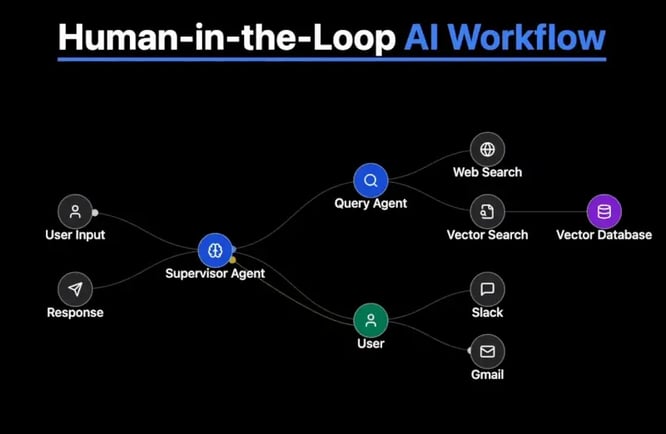
Image Source: LinkedIn
Human-in-the-Loop AI creates substantial benefits for HR departments that go beyond basic automation. A strategic mix of AI capabilities and human expertise brings measurable improvements to key HR functions.
Improved decision accuracy in hiring and promotions
HITL systems make talent selection and advancement decisions better. HR professionals verify AI recommendations to help organizations achieve more precise outcomes than humans or machines could achieve alone. Expert human judgment becomes vital for high-stakes decisions like promotions. These professionals understand context that algorithms can't grasp - they interpret subtle performance patterns and think over cultural fit aspects that data analysis might miss.
Bias detection and mitigation in AI outputs
Human oversight plays a vital role by identifying and fixing biases in AI systems. AI tools that learn from historical data often copy existing prejudices, which could spread discrimination through hiring and management processes. Human reviewers act as ethical guardians who:
- Spot subtle biases that automated tests might miss
- Give feedback that makes models fairer
- Use contextual judgment for unusual cases where AI decisions seem questionable
This shared approach works especially well to address gender and racial biases that might otherwise lead to unfair outcomes.
Increased transparency and auditability for compliance
HITL systems naturally create detailed audit trails that show who made decisions and why. These records build regulatory confidence and match emerging rules like the EU AI Act's Article 14, which requires human oversight for high-risk AI applications. Human verification also adds accountability that protects organizations during compliance checks.
Faster adaptation to evolving HR policies and data
Employment regulations change often, and HITL systems adapt quickly. Human experts can modify AI frameworks to match new legal requirements or company policies. They also know when models need updates due to changing workplace norms or compliance issues. This ensures AI systems stay current without major technical changes.
Boosting trust and user acceptance in AI systems
Human involvement makes employees more confident in AI-powered HR tools. Research shows only half of employees trust AI at work. Having visible human oversight helps staff see AI as a helpful tool rather than a mysterious decision-maker. This change in perception helps AI adoption succeed because employees who trust these systems participate more readily in AI-enhanced processes.
Challenges of Implementing HITL in HR Automation
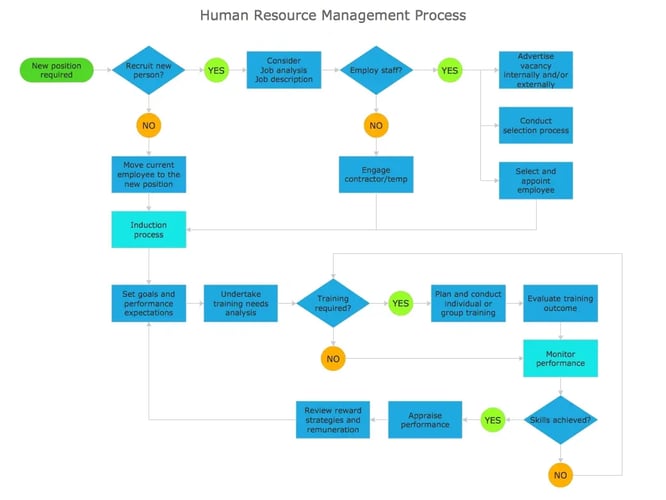
Image Source: Conceptdraw.com
HR departments face real-world challenges that need careful planning to deploy HITL systems. HITL offers many benefits, yet organizations must overcome several hurdles during implementation.
Scalability issues in high-volume HR operations
The presence of human reviewers at multiple stages creates bottlenecks as data volumes grow. Research shows that 42% of companies gave up on most AI initiatives because they lacked proper human oversight and governance. The solution lies in a gradual reduction of items that need review. Companies must retrain their models continuously to achieve higher automation levels.
Latency introduced by human review loops
The "paradox of automation" affects how fast work gets done. Better performing AI systems make humans less eager to participate. These same people must act quickly to fix any automation failures. Research reveals that AI automation reduces physical workload, yet the mental stress of monitoring decisions becomes a big deal.
Cost of expert human oversight
Expert human reviewers need significant resources. Companies must invest in professional development programs to train and keep a workforce that provides quality feedback. We focused on AI literacy programs.
Consistency and training of human reviewers
The core team often lacks the skills needed for proper oversight. About 43% of professionals admit they no longer check AI outputs, even in areas where they have expertise. Organizations need to teach their staff how to interpret AI recommendations. The team should know when to override system suggestions and judge situations where human expertise matters more.
Real-World Use Cases of HITL in HR Workflows
Organizations use HITL approaches in critical HR functions, and real examples show how they balance automation with human judgment.
Resume screening with human validation
Most organizations now use hybrid resume screening where AI filters applications first and human reviewers make final decisions. Recent surveys back this up - 72% of HR professionals say human validation remains essential in hiring decisions. AI adoption in recruitment focuses mainly on resume screening, with 62% of respondents calling it their most valuable tool. Some platforms take it further by having multiple reviewers score anonymous applications based on skills. This method reduces individual bias while keeping the process quick.
AI-assisted performance reviews with manager oversight
HITL systems make performance evaluations better. About 75% of employees like AI-generated reviews when managers check and adjust them. Modern systems look at data from the whole review period - including 1-on-1 notes, goals, and check-ins - to create drafts that managers can improve. Managers can avoid bias from recent events while adding their insights and understanding of context.
Generative AI content moderation in internal communications
HITL systems help protect company standards in internal communications without slowing down message flow. Social platforms use AI to check for policy violations, and human moderators review any flagged content. This system becomes crucial as more organizations use AI for employee communications. It ensures messages stay appropriate and line up with company values.
Human-in-the-loop fraud detection in payroll systems
Payroll operations present perfect opportunities for HITL implementation, especially in stopping fraud. AI systems spot suspicious patterns while human compliance officers decide what needs investigation. This shared approach works well for important financial processes where mistakes can lead to serious legal and money problems.
Conclusion
This piece explores how Human-in-the-Loop AI fills the vital missing layer in HR automation. Of course, AI automation gives HR teams substantial benefits – from better efficiency to evidence-based insights. Notwithstanding that, automated systems consistently fall short when they handle high-stakes decisions that affect people's careers and livelihoods.
Human oversight makes sense because AI lacks contextual understanding and struggles with regulatory compliance. It cannot match human empathy. Failed automated HR systems prove why human judgment cannot be replaced. HITL provides the perfect balance by combining AI's efficiency with human expertise to create more accurate, ethical, and compliant HR processes.
Organizations can adopt different collaboration models based on their specific needs, as shown by Human-in-the-Loop, Human-on-the-Loop, and AI-in-the-Loop approaches. The right approach depends on risk levels, required speed, and context.
HR teams gain most important advantages from HITL systems. These include improved decision accuracy in hiring and promotions, better bias detection, increased compliance transparency, and faster adaptation to evolving policies. It also builds employee trust – a vital factor to successful AI adoption in HR.
The benefits come with challenges. Scalability issues, review latency, expert oversight costs, and reviewer training needs require careful planning. Organizations should develop strategies to overcome these hurdles while the human element that makes HITL valuable stays intact.
Real-life applications show HITL's practical value in resume screening, performance reviews, internal communications, and payroll fraud detection. These examples demonstrate how human validation transforms AI from a potential liability into a powerful asset for HR teams.
Without doubt, HR's future lies where human judgment meets AI capabilities. AI will increase HR professionals' abilities rather than replace them. Human oversight will keep these systems fair, ethical, and working well. The most successful HR automation strategies know that technology works best when human wisdom guides it.
Key Takeaways
Human-in-the-Loop AI bridges the gap between automation efficiency and human judgment, creating safer and more effective HR systems that maintain trust while delivering results.
• Fully automated HR systems fail in high-stakes scenarios - AI lacks contextual understanding and emotional intelligence needed for complex workplace decisions and compliance.
• HITL combines AI efficiency with human oversight - Humans validate AI recommendations, handle exceptions, and provide continuous feedback to improve system performance.
• Human validation dramatically improves decision accuracy - HITL systems deliver better hiring and promotion outcomes than either humans or AI working independently.
• Implementation requires strategic planning - Organizations must address scalability, latency, costs, and reviewer training to successfully deploy HITL systems.
• Real-world applications prove HITL's value - From resume screening to payroll fraud detection, human oversight transforms AI from liability to powerful HR asset.
The most successful HR automation strategies recognize that technology works best when guided by human wisdom, ensuring AI serves as an augmentation tool rather than a replacement for HR professionals.
FAQs
Q1. What is Human-in-the-Loop AI in HR automation? Human-in-the-Loop AI in HR automation is a collaborative approach that integrates human oversight into automated HR processes. It allows AI to handle data processing and initial recommendations while human HR professionals retain control over final decisions and ethical considerations.
Q2. How does Human-in-the-Loop AI improve hiring decisions? Human-in-the-Loop AI enhances hiring decisions by combining AI efficiency with human expertise. While AI systems can quickly screen resumes and identify potential candidates, human recruiters provide the final validation, ensuring that contextual factors and organizational fit are considered in the selection process.
Q3. Can Human-in-the-Loop AI help reduce bias in HR processes? Yes, Human-in-the-Loop AI can significantly help reduce bias in HR processes. Human reviewers act as ethical guardians, identifying and correcting biases that automated systems might miss or inadvertently perpetuate, especially in areas like gender and racial discrimination.
Q4. What are the main challenges of implementing Human-in-the-Loop AI in HR? The main challenges include scalability issues in high-volume operations, potential latency introduced by human review loops, the cost of maintaining expert human oversight, and ensuring consistency in training human reviewers to effectively work with AI systems.
Q5. How does Human-in-the-Loop AI impact employee trust in HR automation? Human-in-the-Loop AI significantly boosts employee trust in HR automation. By maintaining visible human involvement in decision-making processes, it reassures staff that AI serves as a supportive tool rather than an opaque decision-maker, leading to increased acceptance and engagement with AI-enhanced HR processes.
Trusted by 330+ CHROs
See why global HR teams rely on Amber to listen, act, and retain their best people.
