17 min read
Last Updated: 15 October 2026
The right employee experience platform shouldn't feel like solving a puzzle. Yet the average enterprise juggles five HR systems. This creates friction that frustrates employees and overwhelms HR teams.
App fatigue is real. Fragmented processes spread across multiple platforms stall productivity and make it impossible to capture insights about employee engagement and the employee experience.
We've assessed the best employee experience platforms that combine your HR technology stack and turn immediate employee feedback into action. Here are 11 solutions built for enterprise scale in 2026.
inFeedo AI
Image Source: inFeedo AI
InFeedo AI positions Amber as an AI Chief Engagement Officer rather than a traditional employee experience platform built around surveys. The difference matters when retention drives your employee experience management platform strategy.
Key Features and Capabilities
Amber operates on conversational AI that involves employees at career-defining moments: onboarding, project changes, manager transitions, post-promotion periods and pre-exit phases. The platform converts these interactions into ranked attrition risk scores with specific manager actions.
The PTM (People-To-Meet) algorithm identifies employees at risk 60 to 90 days before resignation. This prediction window creates time for career conversations, scope adjustments or compensation corrections that change outcomes. Altimetrik retained 62% of at-risk employees at a 1:400 HRBP ratio.
Silent employees present a critical retention challenge. Workers who don't respond to surveys are 3x more likely to quit than survey respondents. Amber targets this population through behavioral tracking and sentiment analysis across the employee lifecycle. Omega Healthcare lifted response rates from 48% to 80% using this approach.
The platform has 26 psychologist-designed templates built on a validated framework of 7 drivers and 45 elements. Report Studio delivers decision-ready analytics with AI summaries and 50+ filters. It identifies specific problem areas within broader engagement scores. Anonymous Ally provides a confidential channel to raise concerns employees won't attach their name to.
Amber automates 98% of routine HR queries and delivers check-ins through Slack, Microsoft Teams, WhatsApp, email, SMS and web. Genpact deployed Amber across 130,000 employees. Workers who involve themselves with the platform are 2x more likely to stay.
Pricing
InFeedo AI uses quote-based pricing across three modules:
Listening: Continuous feedback, moments-that-matter surveys, PTM algorithm, AI-powered insights and predictive analytics
Automation: FAQ resolution, smart ticketing, workflow automation and service delivery analytics
Communication: Customized campaigns, multi-channel delivery and employee involvement messaging
Contact their sales team to get detailed pricing based on headcount and selected modules.
Who Should Choose inFeedo AI
InFeedo AI fits enterprises where retention challenges justify investment in predictive capabilities. Organizations with high HRBP ratios, distributed teams across time zones or silent employee populations benefit measurably. The platform works for companies needing to surface disengagement before it becomes visible through traditional metrics.
Pros and Cons
Strengths: Predictive attrition detection 60-90 days in advance, 90% response rates on surveys, multi-channel delivery in native work tools, proven 2x retention improvement for involved users and automated HR query resolution
Limitations: Quote-based pricing without published rates, requires HR expertise to interpret predictive insights and complexity may exceed needs of smaller organizations with mature involvement processes
Qualtrics EmployeeXM
Image Source: Qualtrics Learn
Qualtrics EmployeeXM anchors its employee experience platform around enterprise survey infrastructure paired with AI-driven action planning. The platform converts multi-touchpoint feedback into manager-specific recommendations rather than generic reports that sit unread.
Key Features and Capabilities
Prescriptive Insights powered by Qualtrics iQ surface opportunities each manager can take to improve engagement. The system eliminates manual filtering. It identifies focus areas like training and development, then compares team scores against company averages. Guided action planning steps managers through execution with recommended tasks and resources.
Digital Listening Posts create "always on" feedback channels beyond periodic surveys. Frontline employees can submit anonymous feedback and improvement ideas live, with all data compiled in centralized dashboards featuring sentiment analysis. The EX Homepage delivers personalized intelligent analysis through desktop and mobile. It surfaces relevant data via customized notifications and daily digests.
Employer Brand Tracking integrates external feedback from Glassdoor and Indeed into internal dashboards. The system combines third-party reviews with employee listening data for complete brand perception visibility. Benefits Optimizer lets employees weigh trade-offs between different compensation packages and identifies ideal benefits configurations within budget constraints.
Integration capabilities extend across enterprise HR technology. SAP SuccessFactors integration embeds surveys into recruiting pages and learning platforms. The platform connects to ServiceNow and Freshdesk for IT service feedback and ticket routing. Benchmarking draws from IBM Kenexa WorldNorms covering 350 companies across 200+ countries with 15 million employee responses.
Pricing
Qualtrics structures EmployeeXM pricing per employee (total headcount) or per active user, with some contracts based on survey response volume. Pricing has a base platform fee plus per-employee or per-response charges. Volume and multi-year commitments yield discounts. Organizations of 500+ employees achieve pricing below original quotes. Implementation time averages 3 months with 20-month ROI and 17% average discount.
Who Should Choose Qualtrics
Qualtrics fits enterprises running multi-touchpoint feedback programs that require workflow automation and closed-loop tools. Organizations with 10,000+ employees represent 70.69% of the user base. This group has CVS Health, United Health Group, Exxonmobil, and Cigna Healthcare.
Pros and Cons
Strengths: Enterprise-grade integration with APIs and data lakes, reliable uptime with strong customer management teams, survey design functionality superior to most vendors, effective dashboards for managers and executives
Limitations: Complex data exports that require cleanup, expensive for organizations needing simple surveys, learning curve for advanced features, customer support slower for non-premium plans
Microsoft Viva
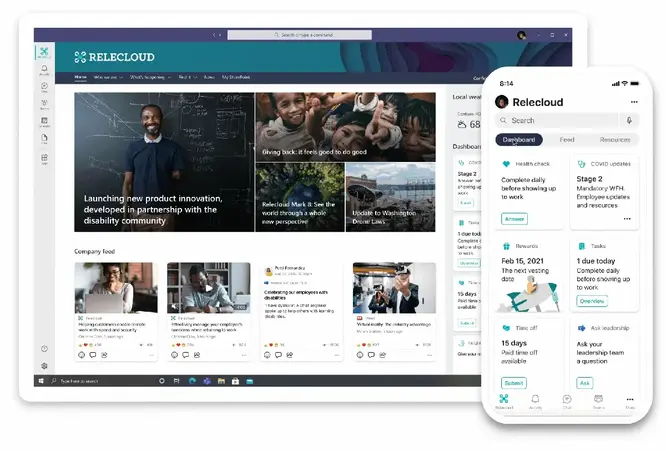
Image Source: erik365.blog
Microsoft Viva operates as an integrated employee experience platform built directly within Microsoft 365 and Teams. The platform combines employee communication, workplace analytics, learning management, and goal arrangement through multiple specialized apps available from existing Microsoft infrastructure.
Key Features and Capabilities
Viva consists of nine distinct modules covering different aspects of the employee experience. Viva Connections delivers a customizable dashboard within Teams and surfaces company news, resources, and internal communications without switching between browsers and applications. Viva Insights provides privacy-protected analytics on work patterns and helps identify meeting overload, after-hours work, and focus time opportunities. Personal insights remain private to individual employees.
Viva Learning brings training content into Teams by connecting organizational learning management systems with third-party providers and Microsoft's LinkedIn library. Viva Topics uses AI to organize content and expertise into categories and displays topic cards when employees encounter unfamiliar terms or acronyms in their workflow. Viva Engage makes organization-wide connections easier through communities and leadership interaction.
Viva Pulse makes it possible for managers to request confidential team feedback using research-backed templates. Viva Goals arranges individual and team objectives with organizational priorities through OKR tracking. Viva Amplify centralizes campaign management for corporate communicators with multi-channel publishing across Outlook, Teams, and SharePoint.
Microsoft Copilot integrates across Viva apps with AI-powered features tailored to each module. But overlapping functionality creates confusion about which tool serves specific purposes. Viva Engage generates tool sprawl concerns as anyone can create channels without oversight.
Pricing
Viva Suite pricing runs approximately $6.80 per user monthly. Individual modules have separate licensing. Viva Connections requires Teams and SharePoint Online licenses at no additional cost. Viva Learning offers a seeded version through Teams with premium features at $3 per user monthly. Viva Insights has free features with Exchange Online.
Who Should Choose Microsoft Viva
Microsoft Viva fits enterprises already committed to the Microsoft 365 ecosystem. Organizations using Teams for collaboration and SharePoint for content management get immediate integration advantages without learning new interfaces.
Pros and Cons
Strengths: Native Microsoft 365 and Teams integration reduces the learning curve, consolidated employee experience across communication and learning modules, privacy-protected personal insights, familiar interface for existing Microsoft users
Limitations: Overlapping features cause internal communication confusion, Viva Insights data limitations prevent a complete picture, risk of tool sprawl with multiple modules, requires monitoring to prevent duplicative channels in Viva Engage
Simpplr
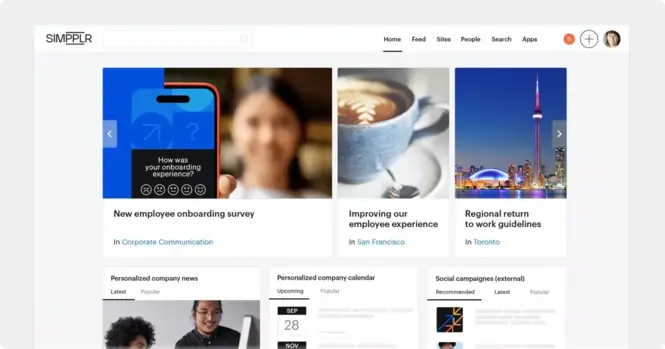
Image Source: Simpplr
Simpplr emphasizes cultural connection and workplace simplicity through an AI-powered employee experience platform that unifies participation, enablement, and services. The platform combines modern intranet capabilities with intelligent automation built for organizations seeking rapid deployment without build-heavy complexity.
Key Features and Capabilities
AI search lets employees ask questions in natural language and get instant answers from all connected systems. The platform keeps information fresh and identifies outdated content without manual oversight. Simpplr connects with 200+ HR and business tools. Employees can complete tasks and launch workflows within the platform without app-switching.
Deployment speed sets Simpplr apart. Organizations roll out in eight weeks for SMBs and 16 weeks for enterprises using prebuilt templates. Pluralsight completed migration in under 30 days. The native mobile app delivers a smooth experience for frontline workers and distributed teams across devices.
Immediate sentiment analysis, participation tracking, and predictive insights support strategic decision-making. The EX Knowledge Graph uses organizational context to tailor communications, search, and recommendations to each person's role, interests, and behaviors. Employees access information and take action without switching systems. This accelerates self-service and reduces the load on HR and IT.
Enterprise-grade security has SOC 2 Type II, ISO 27001, TRUSTe verification, and HIPAA compliance. Simpplr holds 4.7+ ratings across review platforms with zero implementation failures. Organizations achieve 90% employee adoption and 99% global participation. The platform maintains 95% customer retention with 282% return on investment across 2M+ active users.
Pricing
Custom pricing based on organization size and requirements. Volume discounts apply for organizations with 500+ employees. Contact sales for quotes tailored to headcount and complexity.
Who Should Choose Simpplr
Simpplr serves enterprise and mid-market organizations with 1,000+ employees seeking workplace transformation with proven ROI. HR and Communications leaders focused on culture and connection find strong fit, while IT teams gain resilient governance and integration capabilities. Organizations consolidating tools to reduce app-switching and boost productivity through AI-powered automation line up with Simpplr's unified platform approach.
Pros and Cons
Strengths: AI-driven personalization with automated content governance, flexible branding built for complex organizational structures, agentic AI workflows eliminate app-switching, 200+ pre-built connections to systems like Workday and BambooHR, rapid deployment with customers migrating in under 30 days, 4x Leader across Gartner, Forrester, G2, and IDC
Limitations: Enterprise-focused solution may exceed small business needs, configurable but not customizable for businesses wanting complete platform control
Workday Peakon Employee Voice
Image Source: Workday
Workday Peakon Employee Voice builds its employee experience platform on science-backed survey methodology. The platform pairs this with benchmarking data drawn from over 1 billion employee responses and 200 million pieces of written feedback across 160 countries. This dataset scale makes accurate comparisons and consistent measurement possible rather than isolated snapshots.
Key Features and Capabilities
The platform captures employee sentiment across the entire employee lifecycle. It covers engagement, well-being, diversity, retention and leadership development. Gen-AI-powered summaries surface key themes and emerging issues from vast feedback volumes across 60+ languages. Organizations can address concerns like workload or burnout before they fully show. On-demand comment summaries provide targeted analysis by department, location or engagement score.
True Benchmark technology adjusts for demographic variations such as age and location. Managers can assess expected engagement levels with accuracy. Attrition prediction uses AI to forecast turnover risks among different employee populations and helps organizations intervene before talent loss occurs. Peakon focuses on segment-level predictions across teams and locations, while inFeedo AI's PTM algorithm provides 60-90 day advance warning on specific at-risk employees.
Rules-based questions deliver tailored surveys at pivotal lifecycle moments like onboarding and exits. These generate data to improve end-to-end employee experience. Personalized surveys use intelligent follow-up that tailors questions based on recent feedback and lifecycle stage. Confidential two-way conversations make anonymous employee discussions possible. Leadership knows who they're speaking with, but employee identity remains protected.
Survey translations span 65 languages. Dashboards are available in 15 languages. Integration with Microsoft Teams, Slack and REST API makes workflow embedding and data export possible. Deployment completes in weeks rather than months.
Pricing
Enterprise pricing starts at approximately $20,000 annually. SCIM provisioning requires Enterprise tier. Contact Workday sales for headcount-specific quotes.
Who Should Choose Workday Peakon
Organizations requiring global benchmarking in a variety of demographics get clear advantages. Companies with existing Workday HCM infrastructure achieve deeper segmentation by syncing worker data fields. Enterprises needing rapid deployment with verified question libraries and automated scheduling fit the platform's strengths.
Pros and Cons
Strengths: 1B+ response benchmarking dataset, Gen-AI summaries across 60+ languages, True Benchmark demographic adjustments, confidential two-way conversations that maintain anonymity, quick deployment in weeks, 50% time savings for managers and 75% for HR teams
Limitations: Enterprise pricing excludes smaller organizations, no group sync via SCIM despite 2.0 implementation, survey customization restrictions limit school-specific questions, frequent email reminders create notification fatigue
Culture Amp
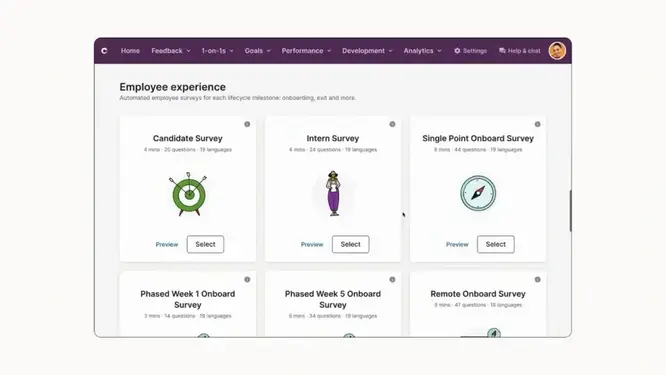
Image Source: Culture Amp
Culture Amp grounds its employee experience platform in organizational psychology rather than reactive feedback collection. The company calls this CultureOS, an intelligence layer that connects engagement data with performance management through people science backed by 1.6 billion questions answered globally.
Key Features and Capabilities
The platform delivers 40+ survey templates designed by organizational psychologists using academic research on employee engagement. AI comment analysis surfaces focus areas automatically, while measuring compares results against the largest employee dataset worldwide. Organizations using the platform experience 2x rate of state-of-the-art solutions, 2x higher customer satisfaction, and 25% greater profitability according to Culture Amp.
AI Coach accelerates manager effectiveness. The tool surfaces engagement survey themes and partners with managers on next steps. It guides complex conversations through expert coaching and role play, creates personalized performance reviews faster, and delivers unbiased individual performance views. The platform arranges corporate and employee goals so workers understand how their contributions push strategy forward.
Performance management tools include continuous feedback and 360-degree reviews with calibrations for fair HR decisions. You also get 1-on-1 conversations, goal tracking, and employee development plans. Culture Amp achieves 40% faster implementation for Enterprise Performance Management compared to competitors. The platform maintains SOC II, ISO, and GDPR compliance with 24/5 product support.
Pricing
| Plan | Employee Range | Features | Support |
|---|---|---|---|
| Self-starter | 25-200 | All Engage + Perform features, limited HRIS integrations | Group coaching |
| Standard | 200-1,000 | Self-starter plus all HRIS integrations | One-on-one coaching |
| Enterprise | 1,000+ | Standard plus People Scientist insights | Dedicated success coach |
Annual costs range from INR 843,804.51 to INR 3,797,120.29 based on headcount and modules. Pricing follows INR 759.42-14 per employee per month.
Who Should Choose Culture Amp
Culture Amp fits mid-size to large organizations that prioritize science-backed engagement surveys with strong analytics. Companies with 500+ employees requiring sophisticated measuring and turnover prediction gain clear advantages. The platform serves 6,000+ companies globally.
Pros and Cons
Strengths: People science foundation with validated survey methodology, extensive measuring from billion-plus response dataset, easy-to-use interface with swift implementation, AI Coach for manager development
Limitations: Higher pricing excludes smaller organizations under 75 employees, limited OKR management versus performance-focused competitors, some analytics features overwhelming for first-time administrators
ServiceNow Employee Experience
ServiceNow Employee Experience distinguishes itself through autonomous AI agents that execute tasks rather than simply providing answers or collecting feedback. Platforms like inFeedo AI focus on retention prediction, but ServiceNow handles operational workflows across HR, Finance, Procurement, Facilities and Legal departments.
Key Features and Capabilities
AI agents within ServiceNow complete end-to-end processes without human help. They onboard suppliers and create leave requests. They process invoices and resolve finance inquiries. Now Assist achieves an 83% average deflection rate. Case summarization for HR agents improves mean time to resolution by nearly 20%.
Employee Center functions as a unified portal. Workers access services, submit requests and complete tasks through tailored dashboards. Knowledge base integration and searchable FAQs reduce live support needs. The ServiceNow app extends these capabilities to distributed teams through mobile access.
Cross-functional collaboration breaks down silos between departments during critical lifecycle moments like onboarding, leaves of absence and offboarding. The platform connects heterogeneous backend systems and provides employees a single layer for interaction. Mondelez International achieved a 76% increase in self-service rates using ServiceNow HR Service Delivery.
Organizations using ServiceNow report 1 million hours of manual task activity saved through AI. Individual implementations save 30,000+ hours each year. CVS Health deployed the platform across 300,000 employees to automate repetitive tasks while maintaining healthcare compliance. More than 85% of Fortune 500 companies rely on ServiceNow AI Platform.
Pricing
ServiceNow uses quote-based pricing for HR Service Delivery. Contact their sales team for custom quotes based on employee count and module requirements.
Who Should Choose ServiceNow
ServiceNow fits enterprises needing workflow automation across multiple departments rather than standalone measurement tools. Organizations with complex backend systems requiring unified employee access points gain clear advantages.
Pros and Cons
Strengths: Autonomous AI agents execute complete workflows, 83% deflection rate reduces HR workload, cross-functional process integration, proven Fortune 500 adoption, mobile Employee Center
Limitations: Quote-based pricing lacks transparency, complexity requires substantial implementation resources, workflow focus may not address measurement needs
Medallia Employee Experience
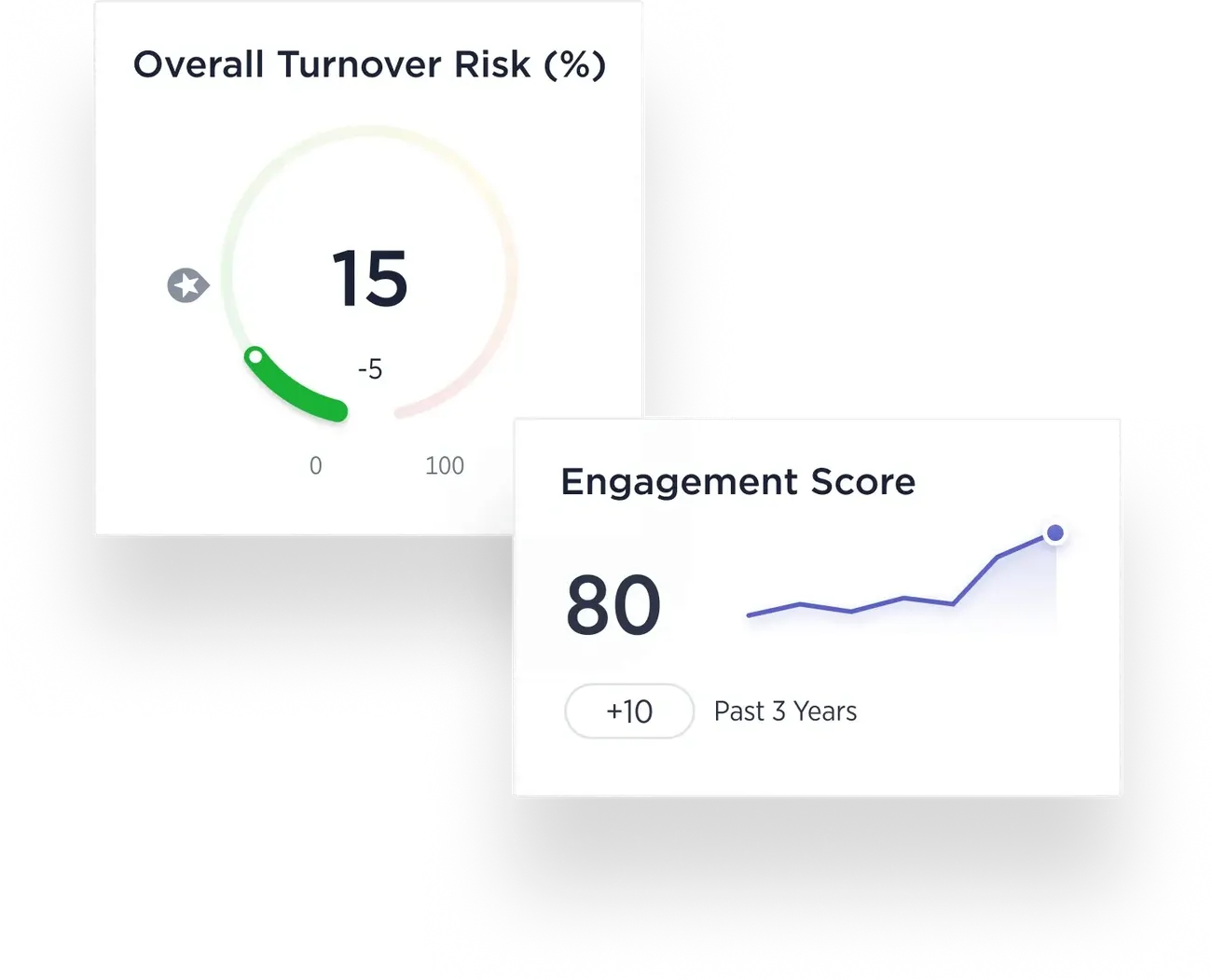
Image Source: Medallia
Medallia Employee Experience connects internal workforce signals with customer experience outcomes through unified analytics. The platform breaks down silos between HR and CX teams by capturing employee feedback among customer data and reveals how internal experiences shape external satisfaction.
Key Features and Capabilities
The platform captures billions of experience signals from voice, video, digital, IoT, social media and corporate messaging tools. This multi-channel approach extends beyond traditional engagement surveys. It has candidate communication, onboarding milestones, DEI signals and exit interviews. AI and machine learning automatically surface predictive insights from structured and unstructured data that has text, video and speech.
Employee Center integrates feedback opportunities into daily workflows. This helps surface critical signals that lie beneath traditional survey responses. Role-based dashboards deliver individual-specific insights tailored to organizational structure. Speech and text analytics process free-form comments to identify hot topics and themes. Up-to-the-minute alerts notify appropriate stakeholders on mobile and web when intervention becomes necessary.
Bank of America implemented Medallia to monitor onboarding programs and captured feedback at mid-point, completion and 60 days post-program. 3M deployed the platform across its workforce to centralize feedback and institutionalize employee listening. Implementation budgets range from INR 42.19M to INR 84.38M typically.
Pricing
Medallia uses Experience Data Record (EDR) pricing rather than per-survey or per-seat models. Each EDR has all platform capabilities: signal capture, AI analytics, workflow automation, unlimited users and security features at no additional cost.
Employee Experience pricing runs INR 1,265.71 to INR 2,953.32 per employee annually. Annual costs range from INR 12,657,067.62 to INR 29,533,157.78 for a 10,000-employee organization. Organizations already using Medallia for customer experience achieve 25-35% discounts when bundling employee experience at contract renewal.
Who Should Choose Medallia
Medallia fits enterprises that just need CX-EX correlation analysis to understand how employee experiences affect customer satisfaction. Organizations with existing Medallia customer experience implementations gain integration advantages and bundling discounts. Companies that just need multi-signal capture beyond surveys line up with platform strengths. This has speech analytics and video feedback.
Pros and Cons
Strengths: Unified CX and EX analytics reveal internal mechanisms of customer friction, multi-channel signal capture from video, speech and social platforms, predictive AI identifies trends before they escalate, EDR pricing has unlimited users and full feature access, proven Fortune 500 adoption that has Bank of America and 3M
Limitations: Enterprise pricing excludes smaller organizations, EDR model requires understanding expected interaction volumes, quote-based pricing lacks published transparency, complexity demands substantial implementation resources
Lattice
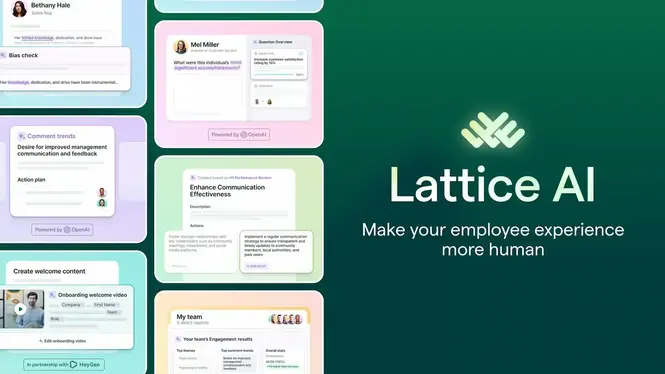
Image Source: Lattice
Lattice delivers modular people management tools built for tech companies managing performance, goals and engagement among distributed teams. The platform serves over 5,000 customers that include Reddit, Asana and Slack.
Key Features and Capabilities
Performance management has continuous feedback, flexible review cycles (annual, quarterly, project-based) and 1:1 meeting tools. AI Coach accelerates manager effectiveness. It surfaces engagement themes and guides complex conversations through expert coaching. The tool creates personalized performance reviews faster. Goal-setting with OKRs connects individual, team and department objectives to business outcomes.
Engagement surveys with AI-powered insights measure satisfaction and gather feedback. The platform integrates with Slack, Teams and Zoom. This makes it suitable for distributed teams. Mobile app functionality allows feedback, reviews, 1:1s and goal tracking from any device.
Lattice focuses on performance and goal management. inFeedo AI specializes in predictive retention analytics with 60-90 day advance warning on at-risk employees.
Pricing
| Module | Price (INR/user/month) |
|---|---|
| Engagement | 337.52 |
| Goals | 675.04 |
| Performance | 843.80 |
| Compensation (add-on) | 506.28 |
| Full Package | 1,096.95 |
Annual billing required with INR 337,521.80 minimum agreement.
Who Should Choose Lattice
Tech startups and scale-ups needing goal alignment and continuous feedback find strong fit. Organizations requiring structured performance reviews with customizable templates benefit. Mid-sized to enterprise companies with 200+ employees represent the core user base.
Pros and Cons
Strengths: Clean interface with easy-to-use navigation, customizable review templates, strong goal-setting capabilities, Slack integration for instant feedback
Limitations: HRIS discontinuing July 2026, goal setup complexity within OKRs, overwhelming feature volume at first, high cost when stacking modules
Darwinbox
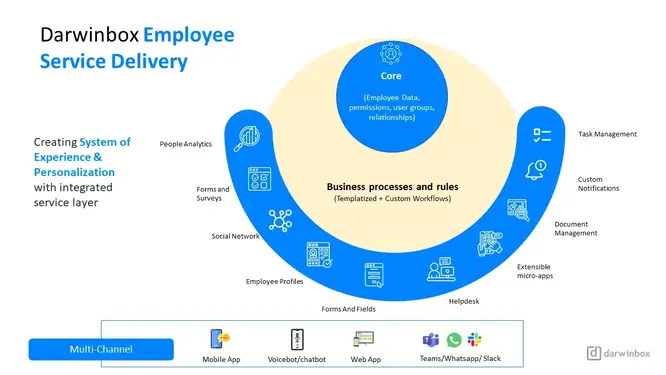
Image Source: Darwinbox
Darwinbox builds employee experience capabilities into its core HCM platform rather than offering standalone tools. Gartner ranked Darwinbox among the top two globally on AI. This proves the integrated approach right where engagement sits among workforce, performance and payroll data.
Key Features and Capabilities
Pulse surveys, eNPS and lifecycle feedback operate within the HCM suite among rewards, recognition and a social employee experience layer. This integration eliminates data silos. HR traces the issue to the same workforce and manager data without exporting between systems when engagement scores dip.
The platform serves over 900 enterprises in 130+ countries with 3 million+ employees. Mobile-first architecture suits distributed and deskless workforces well. Darwinbox earned 4.7 out of 5 stars with 144 verified reviews and recognition as a Customers' Choice in the 2025 Gartner Voice of Customer for Cloud HCM Suites.
Pricing
Indicative pricing ranges from INR 200 to INR 600 per employee per month based on module bundle, headcount tier and contract length. Quote-based model requires direct sales contact.
Who Should Choose Darwinbox
Enterprises wanting experience integrated with core HR on one platform find natural fit, especially in Asia and emerging markets. Organizations in Southeast Asia, India and the Middle East represent the largest customer concentrations.
Pros and Cons
Strengths: Experience data integrated with core HR and payroll, mobile-first design for frontline workers, strong Asia-Pacific market presence, 4.7/5 rating in reviews
Limitations: Quote-based pricing lacks transparency, subscription starts on contract signature rather than go-live, complexity for new users at first
Perceptyx
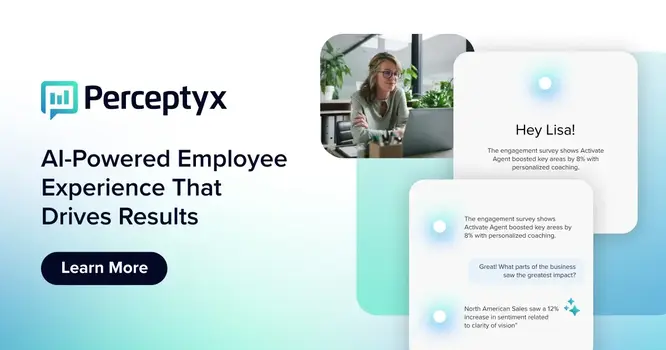
Image Source: www.perceptyx.com
Perceptyx claims recognition as the only platform that handles all four Gartner Voice of the Employee capabilities: employee listening surveys, manager enablement, EX insights management and professional services. Their People Activation System works as a detailed employee experience management platform rather than a survey tool.
Key Features and Capabilities
The platform operates through three listening channels. Ask captures scheduled feedback. Sense monitors lifecycle moments like onboarding, and Dialog makes crowdsourcing possible with voting on solutions. Cultivate delivers manager enablement through 360 feedback paired with AI-driven passive listening that analyzes digital communications. It functions as a "Fitbit for managers" with behavioral nudges.
AI agents power the activation layer. The platform uses discriminative AI to analyze comments, generative AI through Comment Copilot for insights, privacy AI to mask data and rule-based heuristics for automated decisions. Benchmarking draws from 20 million responses spanning 500+ organizations in 226 countries.
Organizations report 95% retention rates that reduce hiring costs by INR 168.76 million, 9% turnover reduction and 40% cuts in top talent attrition. The platform maintains SOC 2 Type II, ISO 27001, FedRAMP authorization and GDPR compliance.
Pricing
Flat monthly fee of INR 4,134.64 for the whole organization, whatever the headcount. No per-employee charges or minimum contracts exist, though consulting portions may vary between year one and renewals.
Who Should Choose Perceptyx
Enterprises that need research-backed listening programs with expert I/O psychologist support find strong alignment. Organizations managing 30% of Fortune 100 companies benefit from the professional services differentiation.
Pros and Cons
Strengths: All four Gartner VoE capabilities in one platform, 20M+ response benchmarking dataset, AI agents driving automated action planning, dedicated I/O psychologist consultants and flat-rate pricing model
Limitations: Enterprise complexity exceeds small business needs, consulting-heavy approach requires partnership mindset and generative AI features are opt-in only
How to Choose the Right Employee Experience Platform for Your Enterprise

Image Source: Customertimes
Define Your Primary Goals
The employee problem should come before product feature comparison. Organizations seeking deep retention measurement benefit from platforms with predictive capabilities. Platforms like inFeedo AI create intervention opportunities before resignations occur with their 60-90 day attrition prediction window. Platforms with integrated goal management fit better when you want to connect engagement to performance. Workflow automation matters more than sentiment analysis if your goal is reducing day-to-day friction.
Review the Action Loop
The decisive test is whether insight becomes action. Look for routing of insights to managers and recommended interventions. You need to know how to track whether engagement or retention changed, not just dashboards. Platforms that collect feedback without acting on it within a reasonable window erode trust faster than not collecting it at all.
Think Over Integration with Existing HR Technology
Surface-level integrations may look strong in demos but create friction during implementation. Connections with HRIS systems like Workday, SAP SuccessFactors and BambooHR should function beyond simple data sync.
Global Workforce Reach Matters
Deskless and distributed employees need mobile-first access and multi-language support. The employee experience platform should reach frontline workers, not only knowledge workers at a desk.
Review AI-Powered Analytics Capabilities
Check whether AI provides prescriptive recommendations or just descriptive reports. Predictive attrition identification creates useful windows for retention interventions.
Calculate Total Cost of Ownership
Calculate expenses over 3 to 5 years, not just first-year costs. Include subscription fees, implementation and migration, training, integration work, internal administration, and support and maintenance. A platform with low subscription price may still have high TCO if it requires heavy administration, training or customization.
Conclusion
You've explored different employee experience platforms and how they address enterprise challenges. Match one with your actual needs.
Identify your main goal first. Organizations facing retention challenges benefit most from predictive capabilities. InFeedo AI's 60-90 day attrition warning creates intervention windows that translate to retention improvements, as Genpact's 2x retention rate among engaged users showed.
But assess total cost of ownership beyond subscription fees. Factor in implementation time and integration complexity.
The right platform solves your employee problem rather than offering the most features.
Key Takeaways
Choosing the right employee experience platform requires matching specific organizational challenges with platform capabilities rather than selecting based on feature count alone.
• Predictive retention beats reactive surveys: Platforms like inFeedo AI identify at-risk employees 60-90 days before resignation, creating actionable intervention windows that achieve 2x retention rates versus traditional engagement tools.
• Integration depth determines real-world success: Surface-level connections create implementation friction—verify platforms integrate beyond basic data sync with your existing HRIS like Workday or SAP SuccessFactors.
• Calculate 3-5 year total cost, not just subscription fees: Include implementation, training, integration work, and internal administration costs—low subscription prices often hide high TCO requirements.
• Action loops matter more than dashboards: The decisive test is whether insights route to managers with recommended interventions and track actual engagement changes, not just collect feedback.
• Mobile-first access reaches your entire workforce: Deskless and distributed employees need multi-language support and native mobile experiences—platforms that only serve knowledge workers miss critical populations.
The average enterprise already juggles five HR systems, creating app fatigue and fragmented processes. The platforms reviewed here consolidate your HR technology stack while turning real-time employee feedback into measurable outcomes. Your selection should solve your specific employee problem—whether that's retention prediction, workflow automation, or cultural connection—rather than offering the broadest feature set.
FAQs
Q1. What is an employee experience platform and why do enterprises need one? An employee experience platform is a unified solution that consolidates HR technology to improve engagement, enablement, and services across the entire employee lifecycle. Enterprises need these platforms because the average organization juggles five separate HR systems, creating app fatigue and fragmented processes that frustrate employees and overwhelm HR teams. A comprehensive platform turns real-time employee feedback into actionable insights while reducing the complexity of managing multiple disconnected tools.
Q2. How do predictive employee experience platforms help with retention? Predictive platforms use AI and behavioral analytics to identify employees at risk of leaving 60-90 days before they resign. This early warning system creates a critical intervention window where HR and managers can have career conversations, adjust workloads, or address compensation issues before the employee makes a final decision to quit. Organizations using predictive capabilities report retention improvements of up to 2x compared to traditional engagement survey approaches.
Q3. What's the difference between employee experience platforms and traditional engagement survey tools? Traditional engagement survey tools primarily collect periodic feedback through questionnaires and generate reports. Modern employee experience platforms go beyond surveys to include continuous listening, predictive analytics, automated action planning, workflow integration, and manager enablement features. They capture signals across multiple channels throughout the employee lifecycle and route insights directly to managers with specific recommended interventions, creating a complete action loop rather than just data collection.
Q4. How much do enterprise employee experience platforms typically cost? Pricing varies significantly based on platform capabilities, organization size, and deployment complexity. Per-employee costs range from approximately INR 200-600 monthly for integrated HCM solutions to INR 1,200-2,900 annually for specialized platforms. Some vendors use flat organizational fees around INR 4,100 monthly regardless of headcount, while others quote custom pricing. When evaluating costs, calculate total cost of ownership over 3-5 years including implementation, training, integration work, and ongoing administration—not just subscription fees.
Q5. What features should enterprises prioritize when selecting an employee experience platform? Enterprises should prioritize platforms that align with their primary organizational challenge. Key features to evaluate include: integration depth with existing HRIS systems beyond basic data sync, mobile-first access for deskless and distributed workers, AI-powered analytics that provide prescriptive recommendations rather than just descriptive reports, proven action loops that route insights to managers with specific interventions, and multi-language support for global workforces. The platform should solve your specific employee problem—whether retention, engagement measurement, or workflow automation—rather than simply offering the most features.
Trusted by 330+ CHROs
See why global HR teams rely on Amber to listen, act, and retain their best people.
