AI in HR reshapes employee management faster than anyone predicted. AI adoption in HR has surged from 19% in 2023 to 61% in 2025 according to Gartner. Nearly 38% of organizations now use AI in their HR functions. This change represents more than a trend—it completely reimagines human resource management.
AI brings advantages that go way beyond the reach of simple automation. Research from 274 IT employees reveals that AI capabilities like accuracy, computing power, and personalization substantially impact time-saving and cost reduction. The future looks bright as 94% of business leaders consider AI crucial for success. HR leaders now have the chance to redesign their entire function through Generative AI and agentic AI. Manual processes give way to automated solutions like chatbots and virtual assistants.
This detailed guide examines why traditional employee management practices no longer work, how AI revolutionizes HR functions, and what your organization must know to keep up with trends in 2025.
What makes traditional HR management outdated
Traditional HR departments don't deal very well with today's dynamic business environment. A revealing statistic shows that 32% of employees find their current traditional HR processes ineffective and unsystematic due to labor-intensive work. Organizations continue to evolve, and these outdated approaches create bottlenecks that affect operational efficiency and employee experience.
Manual processes and inefficiencies
The reality of traditional HR operations paints a sobering picture. HR teams spend countless hours on repetitive administrative tasks that automation could handle. Approximately 73% of HR's time goes into monotonous administrative work, with HR managers losing 14 hours weekly on tasks that could be automated. This administrative load stops HR professionals from focusing on strategic initiatives and value-added work.
Traditional HR management typically relies on:
- Paper-based documentation and records that can get lost, damaged, and breach security
- Manual data entry across multiple disconnected systems that increase errors
- Time-consuming payroll processing that leads to costly mistakes
- Cumbersome compliance tracking and reporting that raise legal risk
Manual HR processes create inefficiencies beyond the HR department. Employees need to work through complicated processes for simple requests like checking benefits or booking leave. These tasks often become support tickets—frustrating employees and taking up HR staff's time.
Lack of personalization and real-time support
Traditional HR approaches can't deliver individual-specific experiences. Legacy HR systems focus on efficiency rather than participation, and they fail to provide context-aware, individualized experiences. 21% of employees can't track and measure their growth or performance through traditional tools.
The lack of real-time capabilities makes these issues worse. Traditional performance management uses annual reviews and paper-based evaluations, which tend to be subjective and lack timely feedback. One expert notes, "Delayed feedback provides information that is often too late to be useful, missing the chance for timely course corrections".
Managers can see huge benefits from real-time employee data that traditional systems can't provide. Modern approaches let managers see what's happening right now and take immediate action. They can reassign tasks, adjust deadlines, or help exactly when needed.
Inability to scale with workforce demands
Traditional HR solutions don't handle growing workforce demands well. Companies that grow face clear signs of strain:
- Non-HR professionals handle HR tasks due to system limitations
- Poor first impressions from inconsistent onboarding processes
- Missing documentation and standardized policies
- No career progression frameworks
Traditional HR structures work in silos, which creates data inconsistencies, inefficiencies, and limited organizational visibility. This fragmentation makes it impossible to create unified employee experiences or get meaningful workforce insights.
Keeping outdated HR approaches has serious consequences. Organizations face inability to meet growth targets due to staffing challenges, lost revenue from unfilled positions, increased compliance risks, and difficulty expanding into new markets. Businesses evolve and workforce expectations change, but traditional HR management falls short.
These limitations show why forward-thinking organizations now turn to AI in HR. This change isn't just about modernization—it fixes fundamental flaws in traditional employee management.
What is Agentic AI in HR
Image Source: Gloat
Agentic AI marks a new chapter in human resource technology that goes beyond simple automation to revolutionize HR operations. These intelligent systems stand apart from previous HR tech tools with capabilities and independence that we haven't seen before.
Definition and core capabilities
Agentic AI in HR represents intelligent, independent systems that understand HR-related tasks, make decisions, and take action throughout the employee lifecycle. These systems run on large language models (LLMs) and advanced machine learning algorithms. They can understand natural language, answer questions, think through scenarios, and learn from new information.
What sets agentic AI apart is how it works with minimal human oversight while pursuing set goals. These systems don't wait for instructions or follow fixed rules. They actively work toward objectives, break them into smaller tasks, and get better over time.
The core capabilities that define AI agents in HR include:
- Autonomous operation: Systems handle complete workflows from start to finish without needing approval at every step
- Goal-directed decision making: Agents receive objectives instead of step-by-step instructions
- Contextual learning: Systems get better as they process more data and see results
- Multi-system integration: Agents work with various HR platforms to access data and take action
How it differs from traditional automation
The difference between agentic AI and traditional automation runs deep. Traditional automation follows set rules and only does what it's programmed to do. Agentic AI, however, understands language, grasps context, makes decisions, and acts without constant human guidance.
Let's look at how each handles HR processes. Traditional automation might move candidates between hiring stages based on fixed rules. Agentic AI can review candidate quality, suggest moving existing employees to relevant teams, and let all managers know automatically.
Traditional automation asks "what task should I complete?" while agentic systems ask "what outcome should I achieve and how do I get there?". This move from task execution to outcome focus shows a fundamental change in HR technology's role.
Adaptability creates another key difference. Traditional automation fails with unexpected situations. Agentic AI can think through new scenarios and make judgments within set boundaries. During benefits enrollment, an agentic system spots unusual requests and either fixes them or asks for human help.
Examples of agentic AI in action
Real results from agentic AI appear across many HR functions. AMD's story stands out - they launched an agentic AI HR system that provided quick, accurate, and tailored support at scale. Their system brought together HR information, enabled self-service for common tasks, and gave role-specific answers. The numbers tell the story: 80% reduction in HR resolution time, 50% of queries resolved via self-service, and 70% increase in employee satisfaction.
A global bank's experience mirrors this success. They made an AI-driven HR assistant their main point of contact for employee support. The system automated answers to common HR questions, gave policy-aligned responses immediately, and sent complex issues to human staff when needed. Results showed a 94% resolution rate for AI-handled tickets and an 83% reduction in HR ticket volume.
Agentic AI shows its value across many HR areas, including:
- Recruitment: Reviews applications against job descriptions, finds strong candidates, and sets up interviews automatically
- Onboarding: Handles setup, policy acknowledgment, training reminders, and answers basic questions
- Performance management: Monitors KPIs, sends review reminders, and helps managers reach their goals
These examples show that agentic AI isn't just theory - it's already changing how HR departments work, making them more efficient while improving employee experiences.
8 Ways AI is Replacing Traditional HR Functions
Image Source: SlideTeam
HR departments are using AI to transform their core functions across industries. Modern AI solutions do more than automate tasks—they make strategic decisions, create customized experiences, and give insights that weren't possible before.
1. AI in recruitment and candidate screening
AI-powered tools help recruiters streamline their hiring process. Companies that use AI Calling Agents to screen candidates saved substantial time. Their automated systems handled about 12 lakh screenings in 2025. This saved nearly four years of recruiter calling time. More than 6,000 companies started using AI Calling Agents in 2025 and created around 11,200 AI-enabled job listings.
AI recruitment tools offer more than just efficiency—they remove human bias. While traditional screening often favors candidates based on gender or education background unintentionally, AI algorithms review candidates based purely on qualifications and experience.
2. AI-powered onboarding workflows
Both organizations and employees benefit from automated onboarding. AI streamlines everything from document collection to account setup through machine learning algorithms and predictive analytics. 65% of HR professionals believe AI in onboarding will boost employee retention, according to IBM.
Hitachi shows a remarkable example. They cut their onboarding time by four days and reduced HR staff involvement from 20 hours to just 12 per new hire with an AI assistant.
3. Live employee support with AI chatbots
AI chatbots have changed how companies support their employees by giving instant answers to HR questions. AskHR, IBM's internal virtual agent, handles more than 2.1 million employee conversations each year and has automated over 80 HR tasks. These systems give quick responses that match payroll and local HR policies.
AI chatbots do more than answer questions. They check on employees, run pulse surveys, and gather feedback. This creates natural conversations that lead to higher participation rates.
4. Customized learning and development paths
AI-powered personalized learning has replaced the old one-size-fits-all training approach. These systems look at employee data like performance metrics, behavior patterns, and feedback to create custom career paths.
Machine learning algorithms assess employee skills and predict development needs. The system then suggests specific training programs that match both personal career goals and company objectives.
5. AI-driven performance reviews and feedback
AI has made performance management more continuous and data-driven. Standard Chartered saw impressive results after rolling out AI features to 85,000 employees. They reported a 36% increase in ease of writing goals, 30% improvement in feedback writing, and almost 50% more employees getting four or more pieces of feedback each quarter.
About 75% of employees support AI-generated performance reviews, provided human managers check and adjust them.
6. Automated payroll and benefits management
Companies have seen impressive gains from payroll automation. RPA and workflow automation have almost eliminated human errors in payroll processing, PTO benefits, and reimbursements. About 59% of organizations reported lower costs after adding automation to their payroll systems.
Both EY and Deloitte found that companies get their investment back in less than a year.
7. Predictive analytics for workforce planning
Organizations can make better decisions using predictive workforce analytics that study past employee data to spot future trends. This technology helps spot at-risk employees, predict who might leave, improve hiring outcomes, and plan succession better.
Machine learning algorithms help forecast workforce needs, identify potential skill gaps, and make proactive decisions about resource allocation.
8. Handling compliance and sensitive issues
AI compliance tools help organizations stay current with regulatory changes. These systems track federal, state, and local updates live and send automatic alerts about new laws.
AI can also look at an employee's role, location, and training history to assign relevant compliance training. For example, it only assigns California-specific sexual harassment training to employees in California.
AI should make human judgment better, not replace it. This partnership between AI capabilities and human insight will shape how HR management evolves.
Benefits of AI in HR
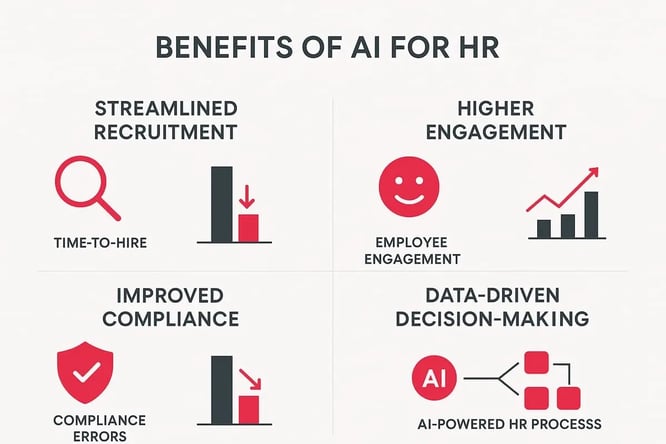
Image Source: Agile HRO
AI's measurable returns in human resources are changing how organizations see their HR departments. Companies that use AI in HR see real benefits in many areas of their operations, not just theoretical advantages.
Improved efficiency and cost savings
Companies using AI in HR see remarkable cost reductions. McKinsey & Company's 2024 State of AI report shows high-performing companies achieve 20%+ year-over-year savings. The financial benefits come from automating administrative tasks. Gartner reports that AI portals for payroll, benefits, PTO, and compliance functions lead to a 30-50% reduction in HR administrative workloads.
These gains show up in several HR areas:
- Recruitment: LinkedIn data shows a 70% reduction in resume screening time with AI-powered matching technologies
- Interview scheduling: Companies save more than 10 hours per week through automated coordination
- Service delivery: IBM's analysis reveals up to 60% cost reduction in HR service delivery through automation
Companies achieve ROI within seven months of implementation. This creates a positive cycle where HR teams can focus on strategic work instead of administrative tasks.
Better employee experience
AI makes a big difference in how employees interact with HR services. Recent surveys show 66% of executives believe AI has a positive effect on employee experience. Employees get tailored, quick support, from learning recommendations to career guidance.
AI-powered systems have transformed service delivery. Microsoft's data shows 60% of service desk questions get answers without human help. IBM's virtual agent handles over 2.1 million employee conversations annually, showing how AI works at scale.
Employees benefit in several ways: quick answers, simpler workflows, targeted learning opportunities, and reliable service quality at any time or place.
Data-driven decision making
AI helps HR teams make better decisions based on evidence rather than gut feeling. HR professionals now have insights that were hard to get before. Teams can spot potential issues early and take action before problems grow.
AI algorithms analyze huge amounts of data in minutes instead of the hours or days humans would need. This helps organizations plan their workforce better by spotting future needs, talent gaps, and the best ways to use resources.
Reduced human bias in hiring
AI shows great promise in reducing unconscious bias in hiring and promotions. It works in two ways: removing human biases and looking at all candidates thoroughly instead of taking shortcuts.
AI-powered recruitment tools have led to a 20% increase in hiring diverse candidates. Well-designed tools can reduce bias in hiring decisions by up to 40%. These tools work because they look at skills and qualifications, not factors that might lead to bias.
The best results come from combining AI tools with human judgment. This approach leads to more diverse teams and better hires overall.
Real-world examples of AI in HR
AI is changing how HR departments work, as shown by real-life examples. Companies using AI agents have seen remarkable gains in both operations and staff satisfaction.
Case study: AMD's AI transformation
AMD, a global leader in high-performance computing and AI solutions, struggled with HR operations. Only 15 HR contact-center employees had to support over 30,000 staff members. AMD teamed up with Kore.ai to create an AI-powered HR agent that solved this problem.
The new system merged naturally with AMD's existing tools. It connected with SAP SuccessFactors, ServiceNow, and Microsoft SharePoint to create efficient HR workflows. Employees could now access a complete HR system directly through Microsoft Teams.
AMD stood out by making everything personal. Their AI agent gave specific answers based on each employee's role, location, and needs. Team leaders could approve requests right from their collaboration platforms, which brought all approvals into one place.
Case study: Global bank's AI helpdesk
IBM created an internal virtual assistant called AskHR, showing how banks can automate HR tasks. The system automated over 80 common HR processes and saved one department 12,000 hours in just three months.
These systems worked well because they balanced automation with human touch. Complex issues went straight to HR professionals, keeping the human element for sensitive matters. This "human-in-the-loop" approach meant AI boosted rather than replaced human judgment.
Key metrics and outcomes
The results of using AI were clear and measurable:
AMD cut their HR response time by 80% after launching their AI agent. Staff got answers in 2 minutes instead of 12. The AI handled 50% of all HR questions without human help.
Employee satisfaction with HR services jumped by 70%. These numbers prove that AI helps both companies and their staff.
AMD saw 20% fewer support tickets within months. Finance teams became 15% more productive with AI automation. Machine learning also helped improve semiconductor manufacturing, saving millions of dollars.
These examples prove that AI in HR delivers real results and changes how organizations manage their workforce.
Challenges and ethical concerns
AI in HR offers many benefits but creates important ethical challenges that organizations must handle carefully. Organizations need to address these concerns as AI systems blend more deeply into workforce management.
Bias in AI algorithms
AI systems learn from historical data and often carry forward existing biases instead of removing them. Amazon's AI recruitment tool showed this problem clearly when it discriminated against female applicants due to training on mostly male resumes. This risk exists because AI suffers from algorithmic bias by reproducing and amplifying human biases.
Legal concerns add another layer of complexity. The Mobley v. Workday case ruled that organizations cannot escape liability by using AI systems for HR decisions. The Mobley court stated that "drawing an artificial distinction between software decisionmakers and human decisionmakers would potentially gut anti-discrimination laws in the modern era".
Data privacy and security
Data privacy has become a major concern, with 72% of workers wanting transparency about how AI is used at work. However, only 34% of HR functions have well-developed data governance policies. This gap creates serious legal and reputation risks.
Current data privacy frameworks don't work well with AI systems that constantly analyze and draw conclusions. HR departments might cross the line between professional monitoring and surveillance without proper protection. Possible risks include:
- Mishandling personally identifiable information (PII)
- Over-surveillance damaging employee trust
- Compliance violations leading to heavy fines
Balancing automation with human oversight
AI makes processes more efficient, but full automation removes the necessary human touch needed in complex situations. Human judgment remains vital when dealing with ethical dilemmas or interpersonal conflicts, especially to interpret regulations in specific contexts.
Organizations should identify which HR tasks work best with full automation and which need human involvement. Tasks with emotional complexity or significant personal impact need strong human participation. Data-heavy, routine tasks can be automated safely.
A "human-in-the-loop" governance model will give accountability by involving experts at key stages—from reviewing training data to checking outcomes. Organizations risk losing the genuine human connection that builds trust and participation without this balance.
Best practices for implementing AI in HR
Image Source: Gartner
Organizations need strategic planning rather than quick adoption of the latest technology to implement AI in HR successfully. Companies can maximize AI's value and minimize potential pitfalls by doing this.
Start with high-impact use cases
AI implementation should be treated as an investment that focuses on specific pain points rather than attempting organization-wide transformation. Most HR teams can create a strong foundation by choosing one vital area—whether slow screening, poor internal mobility, or high attrition. Teams can define clear metrics like time saved, quality of hire, or engagement improvements before scaling with this targeted approach.
Your unique goals should drive the selection of use cases that deliver the highest value, whether that's cost reduction, increased profits, or better employee experience. New tools emerge daily, but not all match your HR team's needs or your organization's technical requirements.
Ensure integration with existing systems
A full picture of your existing HR systems will help identify current workflows and integration points for successful AI adoption. This evaluation will help create an uninterrupted, high-impact integration plan.
Data accuracy stays paramount—careful data mapping and cleansing help standardize formats and fix inconsistencies. Companies benefit from a phased implementation approach that breaks down the process into manageable stages and tests each stage before moving forward.
Maintain human-in-the-loop governance
Two-thirds (67%) of organizations lack any governance model, making AI governance a major barrier to adoption. A dedicated approach will give a responsible way to develop, select, and deploy AI.
A governance committee with HR, Legal, DEI, IT, and Compliance stakeholders helps establish appropriate oversight mechanisms. Human judgment remains part of ethical dilemmas and context-specific situations through this structure.
Train HR teams for AI collaboration
HR teams need to understand what AI is, how it works in their context, and what it means for their roles. Role-specific learning paths should complement formal training for different HR functions—recruiters, HRBPs, learning and development, and payroll.
AI automation of routine tasks will lead HR roles toward more strategic thinking, creativity, and multi-skilled capabilities. HR professionals need ongoing skills development to work effectively with AI tools.
The future of AI in HR
AI continues to evolve from a support tool to an autonomous workforce partner, which reshapes the HR landscape faster than ever. A Gartner study in May 2025 revealed that 44% of HR leaders plan to use semi-autonomous AI agent capabilities within 12 months. However, only 2% expect to deploy fully autonomous agents to replace human workers.
Rise of autonomous HR agents
Software entities known as autonomous HR agents can now make decisions and achieve goals in the digital world independently. HR leaders have shown remarkable confidence in these systems. Two-thirds of them trust these agents to boost employee experiences. These systems will take charge of complete workflows from recruitment to performance management with minimal human oversight.
AI as a strategic partner in workforce planning
AI has moved beyond simple transaction processing to become crucial in strategic workforce planning. Companies that utilize AI-powered workforce analytics can now predict talent needs effectively. They identify skill gaps and create various staffing scenarios with precision. This helps organizations secure the right skills at optimal locations, times, and costs.
Shifting HR from admin to leadership
HR teams ended up moving away from administrative tasks as AI handles the routine work. McLean's research shows that organizations with formal HR strategies perform better in talent acquisition, cost control, and leadership development. HR professionals will spend more time building culture, developing talent, and helping employees' goals line up with organizational objectives.
Conclusion
AI-powered systems have revolutionized traditional HR management and changed how organizations handle their workforce. Today's fast-paced business world has left traditional approaches struggling to keep up. These old methods show clear signs of inefficiency, lack individual-specific experiences, and face scaling problems. Smart companies now choose agentic AI systems that work on their own to make decisions and create individual-specific experiences throughout an employee's journey.
Real-life results tell the whole story. AMD's success shows what AI can do - they cut HR resolution times by 80% and boosted employee satisfaction by 70%. These aren't just empty promises but real benefits. AI systems let HR professionals skip the paperwork and focus on what matters. Employees get better support and individual attention right when they need it.
Some challenges do exist. Teams must think over algorithmic bias, data privacy issues, and strike the right balance between machines and human decisions. But organizations can alleviate these risks with proper governance frameworks and human oversight.
Teams need a smart plan to succeed. The quickest way forward starts with picking the right use cases that make the biggest impact. Organizations should integrate new systems smoothly, set clear rules, and help HR professionals adapt to new roles. This step-by-step approach brings the best results with minimal disruption.
HR professionals shouldn't worry about losing their jobs - their roles will just change. While AI handles routine work, humans can focus on strategy, building culture, and developing leaders. This teamwork between human wisdom and AI capabilities creates an HR department that achieves more than either could alone.
Organizations don't have time to wonder if they should use AI in HR anymore. The real question is how fast they can implement it before others take the lead. Companies that embrace this change will find it easier to attract, develop, and keep talent. This advantage will drive their success as competition gets tougher in the digital world.
Key Takeaways
AI is fundamentally transforming HR from administrative burden to strategic advantage, with organizations achieving measurable improvements in efficiency, cost savings, and employee satisfaction.
• AI adoption in HR has surged from 19% to 61% in just two years, with 94% of business leaders considering it critical for success • Traditional HR wastes 73% of time on administrative tasks, while AI can reduce HR resolution time by 80% and cut administrative workloads by 30-50% • Agentic AI operates autonomously to achieve goals, unlike traditional automation that simply follows predefined rules and requires constant human input • Real-world implementations show dramatic ROI: AMD achieved 70% higher employee satisfaction and 50% self-service resolution rates within months • Start with high-impact use cases and maintain human oversight to maximize benefits while addressing bias, privacy, and ethical concerns effectively
The shift isn't about replacing HR professionals—it's about freeing them from repetitive tasks to focus on strategic initiatives, culture-building, and leadership development that drive organizational success.
FAQs
Q1. What are the main challenges of implementing AI in HR? The key challenges include potential algorithmic bias, data privacy and security concerns, and finding the right balance between automation and human oversight. Organizations need to carefully address these issues through proper governance frameworks and maintaining human involvement in critical decision-making processes.
Q2. How does AI improve efficiency in HR departments? AI significantly enhances HR efficiency by automating administrative tasks, streamlining recruitment processes, and providing instant employee support. For example, AI-powered systems can reduce HR resolution time by up to 80% and cut administrative workloads by 30-50%, allowing HR professionals to focus on more strategic initiatives.
Q3. Can AI completely replace human HR professionals? No, AI is not meant to replace HR professionals entirely. Instead, it augments their capabilities by handling routine tasks, allowing HR teams to focus on strategic initiatives, culture-building, and leadership development. Human judgment remains crucial for complex situations and ethical decision-making.
Q4. What are the benefits of AI-driven performance reviews? AI-driven performance reviews offer more continuous and data-driven feedback. They can increase the ease of writing goals and feedback, improve the frequency of continuous feedback, and provide more objective assessments. However, human managers should still review and adjust AI-generated reviews for accuracy.
Q5. How can organizations ensure responsible AI implementation in HR? To ensure responsible AI implementation, organizations should start with high-impact use cases, ensure integration with existing systems, maintain human-in-the-loop governance, and train HR teams for AI collaboration. It's also crucial to address potential biases, prioritize data privacy, and establish clear ethical guidelines for AI use in HR processes.
Trusted by 330+ CHROs
See why global HR teams rely on Amber to listen, act, and retain their best people.
