Did you know that hr process automation through low-code platforms can reduce development time by up to 90% compared to traditional coding approaches? Your organization can launch solutions substantially faster, and this change affects how HR departments operate in industries of all types.
The benefits of hr process automation are clear in the numbers. Low-code development cuts costs by 50-75% and enables HR professionals to automate routine tasks from resume screening to document processing. On top of that, 29% of organizations complete development 40–60% faster than traditional methods, and another 29% see even better results ranging from 61–100%.
This piece shows how low-code platforms are changing HR systems through visual workflow builders, pre-built templates, and automated processes. Your HR department can move away from manual, paperwork-heavy operations. The result is a simplified, efficient team that focuses on what truly matters—your people.
Why Low-Code is Reshaping HR Workflow Automation
HR departments in various industries don't deal very well with outdated processes that waste valuable time and resources. HR leaders spend up to 57% of their time on repetitive administrative tasks rather than strategic initiatives. Organizations must solve this operational inefficiency to stay competitive.
Manual HR Processes That Slow Teams Down
Traditional HR processes hide costs beyond mere inconvenience. Small and medium businesses spend a full workday each week on administrative HR tasks. This equals one-fifth of the workweek lost to paperwork and manual data entry. So, at a conservative rate of £45 per hour for a business owner or senior leader, these inefficiencies cost about £18,720 yearly per person.
Manual HR operations create major bottlenecks throughout the employee lifecycle:
- Recruitment and Hiring: Manual application sorting becomes tedious without automated systems and risks missing qualified candidates. Hiring timelines stretch unnecessarily due to juggling between job boards, emails, and spreadsheets.
- Employee Onboarding: New hire processing needs multiple departments, dozens of tasks, and weeks of coordination. Paper documentation and manual account setup delay productivity and leave poor first impressions.
- Leave Management: Traditional leave requests lead to confusing email chains, missed messages, and manual calendar updates that frustrate employees and HR teams alike.
- Payroll Processing: Manual payroll leads to calculation errors, tax deduction mistakes, and compliance risks that result in financial penalties.
Data security becomes vulnerable with these inefficiencies. Sensitive employee information stored in paper files and insecure spreadsheets increases the risk of unauthorized access, loss, or breaches that can cause identity theft, financial losses, and legal problems.
How Low-Code Enables Faster HR App Delivery
Low-code development platforms revolutionize HR departments' approach to digital transformation through visual interfaces, drag-and-drop tools, and pre-built components. HR teams can create their solutions with minimal technical expertise instead of waiting months for IT resources.
Speed differences stand out remarkably. Organizations using low-code platforms cut application development time by up to 90% compared to traditional coding. Additionally, 71% of organizations using citizen development speed up application delivery by at least 50%, while 29% see efficiency gains double or more.
Low-code platforms give HR professionals the ability to:
-
Automate complex workflows: Build end-to-end processes for onboarding, leave approval, performance reviews, and training tracking without extensive coding.
-
Integrate disparate systems: Link HR tools with ERP, payroll, and attendance systems through built-in API connectors to eliminate data silos and duplicate entries.
-
Implement live updates: Make immediate changes to forms, approval chains, and business rules without long development cycles.
-
Ensure compliance and security: Keep role-based access controls, audit logs, and encrypted data storage for sensitive employee information.
Low-code platforms let HR experts design their solutions. This democratic approach eliminates the IT bottleneck, where 70% of HR functions face digital transformation delays due to IT dependency. HR professionals can build and modify applications directly instead of explaining requirements to developers, which results in better-tailored solutions.
Organizations see quick returns on investment. Beyond faster development, they report major cost reductions through ready-made UI components, built-in security features, faster deployment, and lower maintenance needs. This makes digital transformation available even for medium-sized organizations with limited IT budgets.
Core Components of Low-Code HR Systems
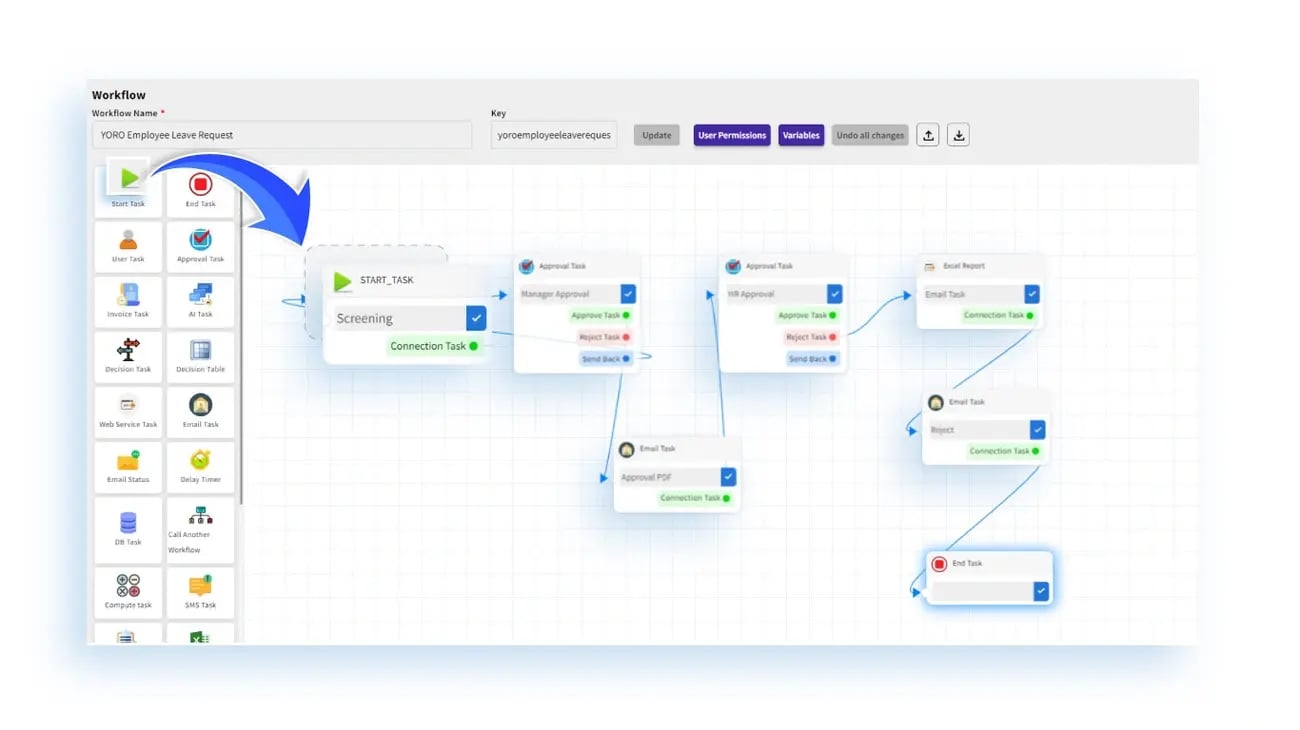
Image Source: Yoroflow
Low-code platforms for HR shine through their specialized components built for human resource operations. These building blocks are the foundations of hr process automation systems that eliminate tedious manual tasks. You don't need extensive coding knowledge to use them.
Drag-and-Drop Workflow Builders for HR
User-friendly workflow builders are the life-blood of modern HR automation platforms. HR professionals can design complex processes with simple drag-and-drop actions instead of writing code manually. These builders started as tools to make application creation easier. Now they include HR-specific elements that match ground department workflows.
HR teams can use drag-and-drop interfaces to:
- Design approval chains for leave requests and expense reimbursements
- Configure dynamic routing based on employee roles and departments
- Set conditional logic for different process paths
- Define automated notifications at each workflow stage
This visual approach removes traditional coding barriers that used to limit HR process improvement. One platform notes that it enables "even non-technical users to design, build, publish, and revise workflows quickly and effectively". HR departments no longer depend on IT teams for routine process changes.
Prebuilt Templates for Leave, Onboarding, and Payroll
Pre-configured templates jumpstart common HR functions and cut implementation time. These templates come with standard workflows, forms, approval chains, and notifications that most organizations need.
The most valuable HR templates cover:
- Employee onboarding sequences that speed up documentation processing
- Performance review cycles with multi-stage feedback collection
- Time-off management workflows with approval hierarchies
- Training and development tracking systems
- Compensation review processes with appropriate security controls
These templates do more than save time - they ensure consistency with internal policies and standards. All HR processes follow set protocols whatever team member starts them. This standardization adds security and audit capabilities, especially for compliance-sensitive processes.
Companies can customize these templates to match their culture. Well-implemented templates adapt to organizational growth while keeping process integrity intact. Yes, it is this balance between standardization and customization that makes template-driven HR systems stand out.
Role-Based Access Control in HR Apps
HR data's sensitive nature makes strong security measures vital for any automation system. Role-Based Access Control (RBAC) tackles this challenge by assigning permissions based on job functions rather than individuals.
RBAC systems work on three key principles:
- User role assignment - Access rights based on positions or tasks
- User role authorization - Approval confirmation for specific functions
- Permission definition - Exact actions users can perform
This approach brings notable benefits to HR applications. To cite an instance, organizations might let "HR managers update employee details, while other employees would be able to view only their own details". Such detailed control prevents unauthorized access to sensitive information like compensation data or performance evaluations.
RBAC makes security management easier by focusing on roles instead of individual permissions. Administrators just assign new roles when employees change positions, which updates all access rights automatically. This cuts down administrative work while boosting security.
The benefits of hr process automation grow through proper role setup. RBAC systems keep detailed logs of system access to support compliance requirements and provide audit trails for sensitive actions. HR departments with strict regulatory requirements around employee data find this capability particularly valuable.
Low-code platforms create a strong foundation for modernizing HR operations without deep technical expertise by combining these three core components—visual builders, pre-built templates, and role-based security.
Automating HR Workflows with Visual Logic
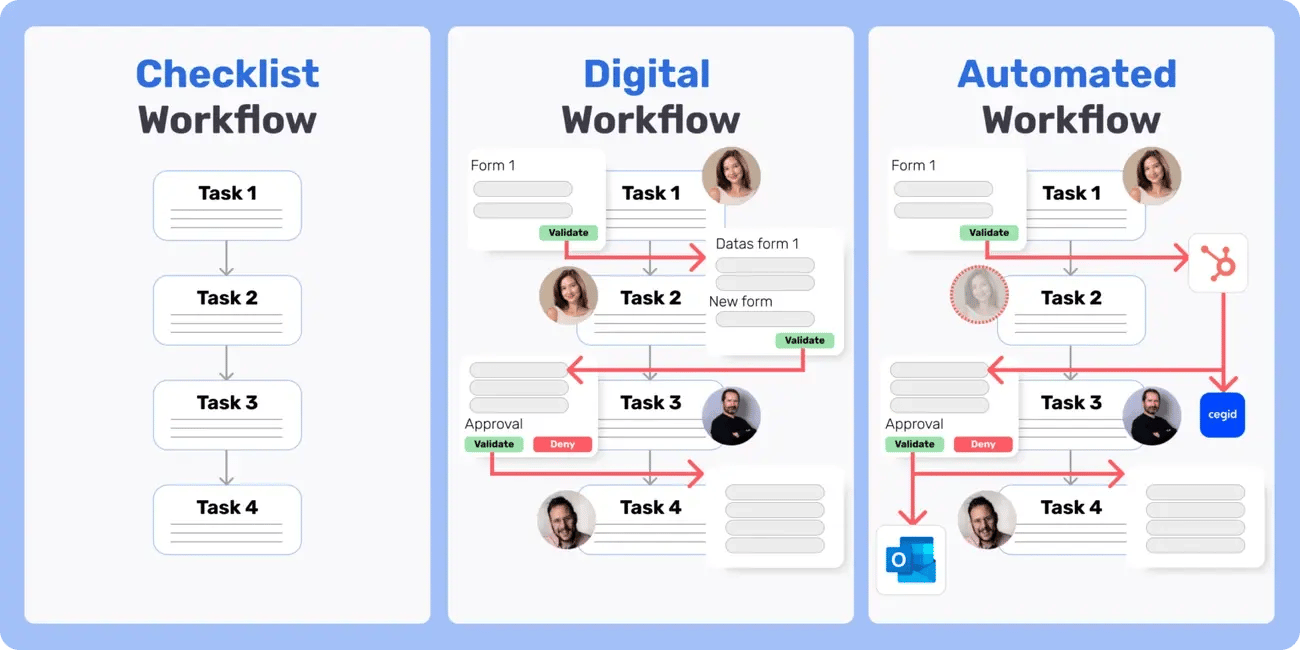
Image Source: Lapala
Visual logic changes abstract HR workflows into tangible, automated processes without complex coding. Organizations that implement hr process automation learn to standardize critical functions through accessible interfaces.
Automated Approval Chains for Leave Requests
Sequential approval chains completely change how organizations manage time-off requests. Traditional email-based approaches have given way to automated chains that route each request to the right approver in the correct order. To cite an instance, a manager reviews the request first, followed by department heads, and HR ended up with final processing. This structured routing eliminates confusion and creates reliable audit trails.
The best leave management systems use conditional logic that adapts to different scenarios. Higher-value requests (like extended absences) route to finance for review automatically, while routine requests follow standard paths. This smart routing speeds up approvals and you retain control.
Administrators can customize multiple approval levels based on organizational hierarchy:
- First-level approvers typically include direct managers
- Second-level might involve department leaders
- Final approvers often include HR managers for policy compliance
These systems can be configured to "auto-approve" at the time designated approvers are unavailable, which prevents bottlenecks and maintains process integrity. This feature ensures business continuity whatever individual availability.
Trigger-Based Notifications for HR Events
Automated notifications act as the communication backbone of modern HR systems. These alerts activate based on specific conditions or events and create timely awareness without manual work. Important HR events—from employee onboarding completions to upcoming review cycles—notifications automatically alert relevant stakeholders.
Trigger-based notifications shine through their precision and reliability. These systems can handle the entire employee lifecycle:
- Alert managers when compliance tasks are completed
- Notify HR teams when all onboarding steps are finished
- Send deadline-based reminders for pending actions
- Generate notifications based on employment dates
Therefore, organizations can eliminate forgotten tasks and miscommunications. One implementation example shows how notifications trigger only after completing all required onboarding tasks, which ensures HR teams receive alerts at the right moment. The system holds notifications until meeting all prerequisites, which prevents premature actions.
Custom triggers provide exceptional flexibility and allow notifications based on any condition—from task completion status to time-based thresholds tied to employment dates. This programmable approach keeps communications relevant and actionable.
Data Sync with Payroll and Attendance Systems
Live data synchronization between HR systems solves the traditional data silo problem that affects manual processes. With automated integration, employee information entered in one system shows up in connected applications automatically. This creates continuous data flow throughout the organization without duplicate entries.
We benefit from data integration capabilities in HR departments by:
- Eliminating manual double-data entry between systems
- Creating data continuity throughout the organization
- Reducing human error through automated updates
- Enabling complete, accurate reporting
Organizations can choose different synchronization approaches based on operational needs. Options include live syncing for immediate updates, scheduled batch synchronization, or event-triggered syncs based on specific workflow conditions. HR teams can balance system performance with data freshness requirements.
Middleware solutions handle complex data mapping between different systems behind these integrations. Prebuilt connectors extract data from source applications while transformation rules convert information to meet target system requirements. HR professionals save countless hours that would otherwise go into manual transfers between disconnected platforms.
The benefits of hr process automation go beyond time savings. Integrated HR systems are the foundations of strategic decision-making while reducing compliance risks from outdated or inconsistent information.
Benefits of HR Process Automation Using Low-Code
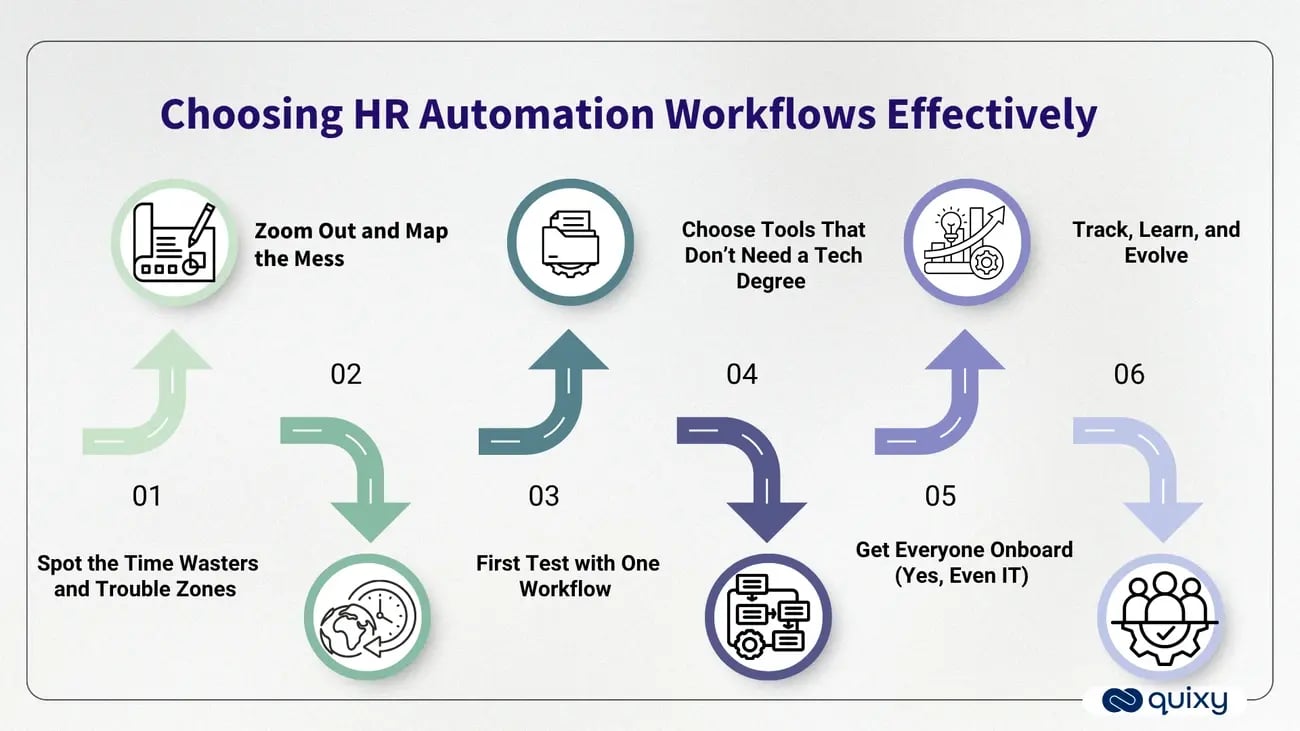
Image Source: Quixy
Low-code HR automation brings measurable benefits to human resource management. Organizations using these solutions see substantial improvements in efficiency, compliance, and cost structures that directly affect business results.
Reduced Time-to-Hire with Automated Recruitment Flows
Traditional recruitment processes take too much time and resources. Companies using low-code automation report dramatic improvements in hiring efficiency. Studies show that automated recruitment workflows can cut time-to-hire by up to 45%, which speeds up executive search cycles. This speed boost helps organizations secure top talent in competitive markets.
AI-powered screening systems have changed candidate evaluation by analyzing thousands of applications instantly. Manual resume reviews that took weeks now take minutes. Automated scheduling eliminates coordination delays through calendar syncing and self-service booking options.
Benefits flow throughout the recruitment pipeline. Companies achieve 25-40% faster hiring cycles and cut manual screening work by 50% through automated workflows. These improvements speed up hiring and keep candidate communication consistent, which creates a better experience for potential employees.
Improved Compliance Through Audit Trails
HR must follow strict compliance rules that need detailed documentation. Low-code platforms strengthen compliance with built-in audit features that create detailed records of system activities. Research shows these workflows generate audit trails with time-stamped logs to confirm policy acknowledgments and verify approval chains.
Audit trails provide evidence during regulatory reviews and help spot compliance gaps early. The U.S. Equal Employment Opportunity Commission recovered nearly INR 59066.32 million for over 21,000 workplace discrimination victims in 2024 alone. Automated systems help organizations avoid these costly penalties through proactive compliance monitoring.
Organizations benefit from continuous monitoring that supports root cause analysis and spots problematic patterns during audits. HR departments dealing with strict regulatory requirements find this feature valuable for employee data management.
Lower Operational Costs via Self-Service Portals
Self-service portals cut administrative costs by letting employees manage their information. Organizations report impressive savings - up to 80% in data entry and administration costs, 81% in paper and printing expenses, and 80% in employee query handling costs.
Employees can update their profiles, check leave balances, submit requests, and access important documents without HR help. Companies using employee self-service platforms see up to 65% less HR workload within three months.
Cost savings appear across HR operations. Organizations need fewer external software solutions, depend less on engineering teams, and smaller HR teams can support larger workforces.
A comparison between traditional HR process costs and self-service portal implementation showed annual savings of approximately INR 3248647.36. Data accuracy improves too - data errors drop by 50% when employees manage their own records.
Integrating Low-Code HR Tools with Legacy Systems
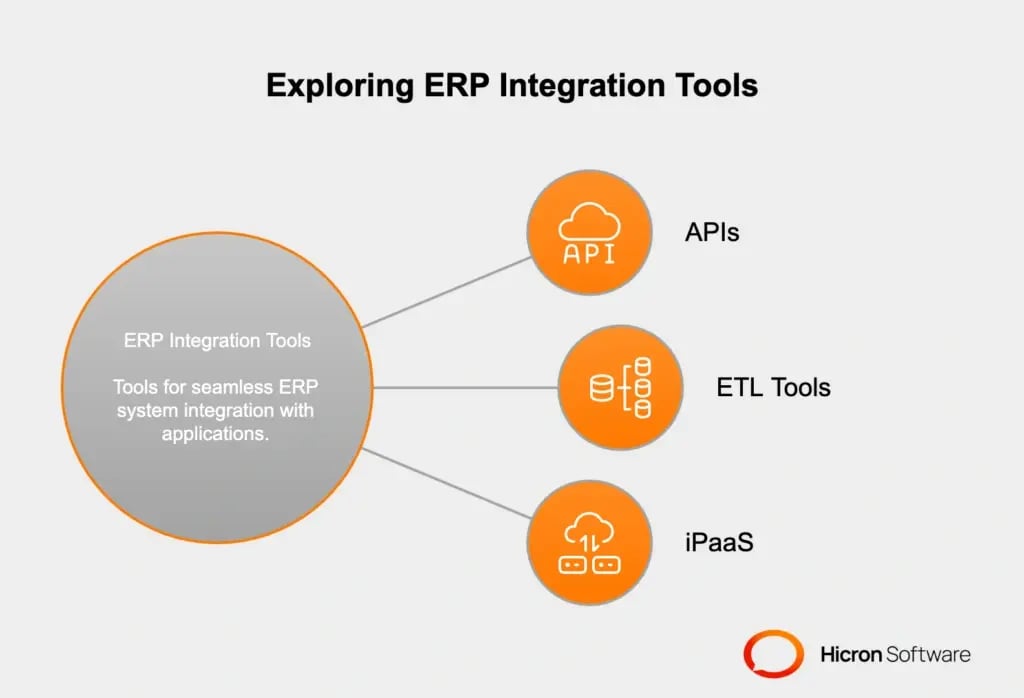
Image Source: Hicron Software
HR departments face a unique challenge when they connect modern low-code platforms with existing enterprise systems. Legacy applications hold years of vital employee data but don't have the flexibility of newer technologies. Low-code platforms bridge this gap with strong integration options.
API-Based Integration with ERP and Payroll
Application Programming Interfaces (APIs) connect HR systems with core enterprise applications like ERP and payroll. These interfaces help systems "speak the same language" and create a single, accurate source of truth for the organization. Companies can arrange workflows between departments and platforms through proper API implementation. They can speed up their processes with reusable integrations.
Low-code platforms excel at making complex API interactions simple. Their pre-built connectors take care of authentication, retry logic, and error management. HR teams don't need to worry about technical implementation details. This approach eliminates manual integration tasks that usually take up development resources.
This integration approach offers several advantages:
- Operations scale smoothly without architectural rewrites
- New services integrate without disruption
- Applications decouple to reduce technical debt
- Integration costs drop by 50-70% with simpler development
Enterprise low-code tools come with built-in connectors for legacy systems, cloud applications, and databases. Integration no longer slows down progress. REST API approaches work well for systems without modern APIs. Teams can make legacy systems available through APIs. This creates an infrastructure that makes data connections between applications easier.
Using Webhooks for Real-Time HR Data Updates
Webhooks offer another way to integrate systems. They provide live notifications when HR system data changes. Traditional methods constantly check for updates. Webhooks only send notifications when specific events occur. This significantly reduces the load on infrastructure.
For hr process automation, webhooks bring several benefits:
- Quick decisions without manual data change checks
- Better data sync for critical tasks like tax deductions
- Lower API costs with fewer calls
- Better system performance with reduced queries
Webhooks power essential HR events like employee information updates, hiring process notifications, leave management, and payroll processing. Employee information changes - address updates, marital status changes, or new emergency contacts - trigger immediate notifications to administrators. This keeps critical HR processes up to date.
Webhooks protect sensitive employee data during transmission when proper security measures are in place. This feature proves valuable for managing compliance-related employee information that needs careful handling.
The benefits of hr process automation through integration show in real business results. Companies see faster hiring cycles, better employee experiences, and smarter resource use across HR functions.
Scaling and Governing Low-Code HR Platforms
Low-code platforms are spreading rapidly across organizations. A proper governance system will give a solid foundation for growth. The numbers tell an interesting story - 73% of low-code planners haven't set up any governance rules for their implementations. This creates major risks.
Version Control for HR Workflows
HR workflows can be exported as JSON structures that work like source code. Teams can track changes between versions easily, unlike traditional HR processes that lack this visibility. A complete version control system needs key details:
- Who made the changes
- When changes happened
- Optional messages about changes
- Version ID or hash
Teams can build valuable audit trails and restore previous versions if new changes cause problems. Automated version control helps HR departments use the latest templates. This keeps employee documents compliant.
Access Policies for Sensitive Employee Data
HR teams handle sensitive information, so data protection isn't optional. Good access policies spell out which employees can view, edit, or use specific HR information. Organizations should put these elements in place:
- Clear statements about what policies cover
- Who approves access requests
- Rules based on giving minimum needed access
Data stays secure through encrypted storage and proper permissions. This prevents leaks and compliance issues.
Monitoring Usage with Built-in Analytics
Insight cards show you the top creators, applications, and workflow status. These live analytics point out which processes need updates or should be removed when they're not used. This keeps the platform running smoothly.
Complete monitoring protects against shadow IT risks. It tracks performance, uptime, and how people use the system. Organizations get full visibility into their hr process automation investments.
Conclusion
Low-code HR platforms have transformed human resource operations in any discipline. The combination of visual workflow builders, pre-built templates, and role-based security mechanisms creates strong foundations to modernize HR departments without extensive technical expertise.
Companies that adopt these technologies see dramatic improvements in multiple areas. HR teams cut their administrative work by up to 57%, which lets professionals concentrate on strategic initiatives instead of paperwork. It also speeds up digital transformation initiatives with a 90% reduction in development time compared to traditional coding approaches. Implementation costs drop by 50-75%.
User-friendly self-service portals stand out as one of the most effective parts of modern HR systems. These interfaces give employees the ability to manage their own information. This results in 80% lower data entry costs and 81% reduced paper expenses. HR departments become efficient teams that focus on high-value activities rather than routine data processing.
Automated audit trails and standardized processes improve compliance management by a lot. Built-in governance features ensure version control, proper access policies, and live analytics that keep data secure. User-friendly integration tools connect modern low-code applications with legacy systems through APIs and webhooks to create unified data ecosystems.
The future looks bright as HR automation becomes available to organizations of all sizes. Teams that once relied on IT departments can now create and modify their own applications. This spreads technology development throughout the enterprise. Low-code platforms will continue to mature and expand the role of citizen developers.
This technological progress marks a turning point for HR professionals. Teams that embrace these powerful automation tools will realize the full potential of unprecedented efficiency. This allows them to focus their expertise on what matters most—developing human capital and creating exceptional employee experiences.
Trusted by 330+ CHROs
See why global HR teams rely on Amber to listen, act, and retain their best people.
