17 min read
Last Updated: 5 November 2026
Choosing the right employee experience platform can determine whether healthcare and finance teams retain talent or lose employees to burnout. Highly regulated, high-pressure workplaces need a digital employee experience platform that does more than run engagement surveys. We assessed tools for employee feedback, people analytics, and workplace experience, including Microsoft Viva employee experience platform, Akumina employee experience platform, EmpXP employee experience platform, and other AI-powered employee experience platform tools. inFeedo AI stands out for HR technology leaders who want smarter employee engagement and stronger retention outcomes. Here are our top eleven picks.
1. inFeedo AI — Best-Suited Choice for AI-Powered Employee Listening and Retention
Image Source: inFeedo AI
I tested several options, and inFeedo AI stood out for HR technology teams that need to identify disengagement before it leads to employee turnover. Amber, the platform's agentic AI system, draws on nine years of People Science research. It centers on three connected modules: Listening, Communication, and Automation. Healthcare and finance HR leaders can move beyond annual surveys and treat employee feedback as an ongoing conversation instead of a yearly checkbox.
inFeedo AI key features and people analytics
Amber gathers feedback through pulse and lifecycle surveys. It tracks sentiment from the offer letter through the exit interview. Its proprietary PTM, or People-to-Meet, algorithm identifies disengaged and silent employees through passive signals in existing HR data. The framework uses 80 million employee responses and 26 templates designed by psychologists. These templates cover 7 engagement drivers and 45 elements. Lens serves as an AI People Scientist for people analytics. It answers questions about PTM, pulse, tenure, and exit data, then creates summaries and reports in seconds. inFeedo AI reports a 90% survey response rate through Amber. Three peer-reviewed publications have confirmed the model, and institutions such as Harvard teach it.
inFeedo AI healthcare and finance use cases
BFSI organizations use Amber to keep HR connected with field agents across branches. Healthcare providers use the platform to reduce burnout through continuous feedback. Banks and insurance companies use the conversational AI anonymously to uncover stress and workload concerns within high-pressure teams. Hospitals and clinics use pulse surveys to monitor burnout and morale among frontline staff. Omega Healthcare increased survey response rates from 48% to 80% after adopting Amber's behavioral tracking approach in one documented deployment.
inFeedo AI integrations, security, and implementation requirements
inFeedo AI connects with more than 35 systems through over 100 integrations across HR, IT, and finance. These include Darwinbox, Workday, and SAP SuccessFactors. Employees can access Amber through email, Microsoft Teams, Slack, Google Chat, or WhatsApp. No app download is required, and the platform supports 34 languages. The platform holds ISO 27001 and ISO 22301 certifications and complies with SOC 2 Type II. It also meets GDPR, CCPA, and LGPD requirements. AES-256 encryption protects data in transit and at rest on AWS. inFeedo AI operates in more than 75 countries. Customers can choose servers in the US, EU, India, or Indonesia.
inFeedo AI customer testimonials, measurable outcomes, and limitations to verify
Genpact deployed Amber to 130,000 employees and found that employees who participate are 2x more likely to stay. The metric now determines the bonus pool for more than 200 leaders. IIFL's Chief People Officer, Priti Shetty, reported an engagement score of 84 and said AI automated 98% of routine queries. Altimetrik retained 62% of at-risk employees while maintaining a 1:400 HRBP ratio. The PTM algorithm identifies risk 60 to 90 days before resignation. Silent employees who skip surveys are 3x more likely to quit than respondents. Pricing is quote-based, with no public rates available. HR teams also need some analytics expertise to interpret predictive insights, and smaller organizations with simpler processes may not need the platform's full depth.
inFeedo AI pricing and best-fit organizations
inFeedo AI offers Listening, Automation, and Communication as separate modules. Each module has a custom quote based on headcount and selected features. The platform suits enterprises with high HRBP ratios, distributed or field-based teams, and many silent employees who rarely respond to standard engagement surveys.
2. Microsoft Viva — Best for Employee Experience Within Microsoft 365
Image Source: Microsoft
Microsoft Viva takes a different approach than inFeedo AI's standalone listening engine. Rather than requiring a separate app, it brings the employee experience into Microsoft 365 and Microsoft Teams. Healthcare systems and financial firms already using Microsoft infrastructure can avoid adding another tool to employees' daily workflows.
Microsoft Viva key features and people analytics
The suite includes seven connected apps. Viva Connections provides company news, policies, and benefits through a customizable Teams dashboard, while Viva Amplify centralizes campaign publishing across Outlook, Teams, and SharePoint. Viva Engage makes community building and knowledge sharing easier, and Viva Learning brings training content from sources like SAP SuccessFactors, Cornerstone OnDemand, Skillsoft, and Udemy into employees' daily work. Viva Insights provides people analytics by analyzing Microsoft 365 collaboration data with organizational HR data. It generates insights for individuals, teams, and leaders, along with a Copilot Dashboard that tracks AI readiness, adoption, and sentiment. Viva Pulse allows managers to run quick, research-backed surveys and monitor sentiment trends over time.
Microsoft Viva healthcare and finance use cases
A reviewer in a regulated industry created a customized dashboard with direct links to financial reports and policy documents. They described it as a custom homepage for the information their department needs each day. This setup works well for finance teams that need fast, role-based access to compliance materials without leaving Teams. Hospital administrators can also use the Connections dashboard to share policy updates and route shift resources.
Microsoft Viva integrations, security, and implementation requirements
Microsoft Viva inherits Microsoft 365 security controls, including role-based access controls, Microsoft Entra ID authentication, and multifactor authentication. Viva Insights and Viva Pulse also use role-based restrictions because they handle sensitive HR data. Viva Connections integrates with ServiceNow, UKG, Moveworks, and Blue Yonder, among other platforms, while Viva Goals supports dozens of partner integrations. Admins can deploy the suite through guided setup tools in the centralized Microsoft 365 admin center.
Microsoft Viva customer testimonials, measurable outcomes, and limitations to verify
Gartner reviewers identify Viva's Teams and Microsoft 365 integration as its strongest asset. They also warn that Viva Engage can create duplicate, unmonitored channels and that Insights may dismiss valid email data. Independent scores give Viva Connections an 8.1 out of 10 composite rating, with an 87% likelihood to recommend and a 98% plan-to-renew rate. SharePoint dependency can frustrate teams that lack a mature intranet. Viva Engage scores 8.2 out of 10, with an 84% likelihood to recommend, although reviewers cite limited personalization compared with consumer-grade platforms.
Microsoft Viva pricing and best-fit organizations
Personal insights are included with most Microsoft 365 plans. Premium analytics, Pulse, and Amplify require a standalone Viva subscription or the Viva Suite add-on, which is licensed per user in addition to an existing Microsoft 365 base plan. Viva suits organizations already standardized on Microsoft 365 that want to bring workplace experience into existing tools. Organizations that need dedicated AI-driven employee feedback and retention modeling, as covered under inFeedo AI, often use both rather than choosing one platform over the other.
3. Workday — Best for Connecting Employee Experience With Core HR
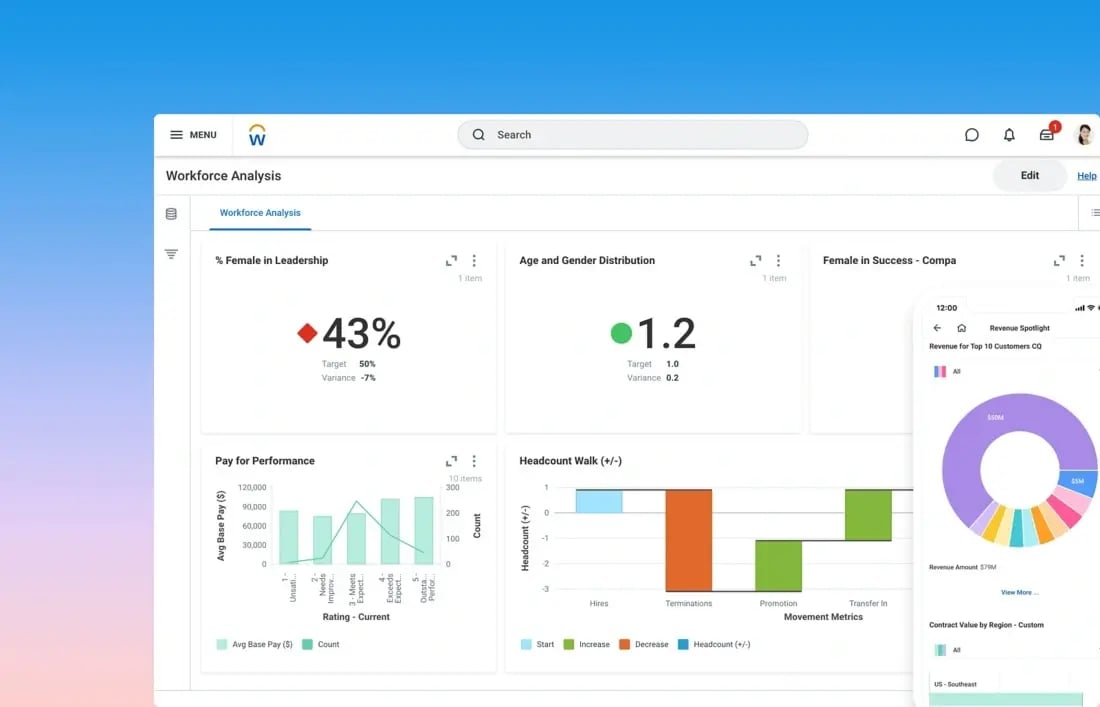
Image Source: Workday
Workday takes a different approach to employee experience than inFeedo AI and Microsoft Viva. Instead of treating engagement as a standalone function, it integrates sentiment data into a unified HR and finance backbone. This appeals to organizations that already manage payroll, benefits, and financial operations on one platform.
Workday key features and people analytics
Workday People Analytics uses increased analytics to highlight prioritized insights across the VIBE Index, Workforce Composition, Retention and Attrition, Hiring, Talent and Performance, and Skills. It also provides natural-language summaries. Workday Peakon Employee Voice includes intelligent surveys with adaptive follow-up questions, True Benchmark technology that accounts for demographic variation, and attrition prediction models. Forrester found that Peakon saved managers 50% more time and HR workers 75% more time, with a 224% return on investment. This listening layer connects to Workday's wider HCM data, while inFeedo AI offers Listening, Communication, and Automation as dedicated modules focused on engagement and retention.
Workday healthcare and finance use cases
Healthcare deployments have reduced nurse onboarding time by 75% and delivered a 751% ROI within two months through value-based insights. St. Luke's University Health Network reported a 50% increase in nurse retention after launching its app. ChristianaCare reduced its month-end close from seven days to four and cut bank reconciliation from 150 hours to 30 minutes. M Health Fairview also reduced cycle times from weeks to hours with Adaptive Planning. More than 850 healthcare organizations run their operations on Workday. The platform processes more than 93B journal lines each month for customers that hold 19.6% of the cloud ERP for finance market.
Workday integrations, security, and implementation requirements
Workday Orchestrate links HR, finance, and third-party systems through a low-code visual builder and live, high-volume batch processing. Security applies automatically across workflows. SOC 1 and SOC 2 Type II audits, ISO 27001, 27017, and 27018 certifications, AES-256 encryption, TLS transport, SAML single sign-on, and multifactor authentication support the platform's security framework. Disaster recovery targets a 12-hour recovery time and a one-hour recovery point objective. Adaptive Planning takes an average of 4.5 months to deploy. Midsize customers using Workday GO have gone live within eight weeks, while complex enterprise rollouts may take many months.
Workday customer testimonials, measurable outcomes, and limitations to verify
More than 11,000 organizations run on Workday, including over 65% of the Fortune 500. KLAS has named it Best in KLAS ERP (Large) for nine consecutive years. Philips' Global HRIS Architect highlighted the clarity that Workday provides across HR and finance. Workday does not publish pricing as a standard dollar figure, and its broad range of modules may require more configuration than a focused listening tool.
Workday pricing and best-fit organizations
Adaptive Planning lists its price as "pricing varies." The company offers a 30-day trial before providing a custom quote based on employee count. Forrester estimated a 242% three-year ROI, although G2 reports an average 16% discount and a 21-month payback period for buyers. Workday suits large, multi-entity healthcare and finance institutions. Teams that want a dedicated AI-driven listening engine often pair it with inFeedo AI.
4. ServiceNow — Best for Employee Service Delivery and Workflow Automation
ServiceNow changes the focus from engagement surveys to service delivery, treating HR, IT, and workplace requests as workflows that AI agents resolve instead of feedback loops that require interpretation. HR Service Delivery (HRSD) routes requests, triggers workflows, and automatically resolves common tasks throughout the employee lifecycle, from hiring to exit.
ServiceNow key features and people analytics
HRSD uses an Employee Center that gives workers one place to search, ask questions, or take action across HR, IT, and facilities systems. AI agents manage repetitive approvals and administrative tasks that would otherwise fall to HR staff. HR analytics within the platform brings together recruitment, onboarding, retention, and performance data to identify employees at risk of leaving. It follows a four-stage model: collection, measurement, analysis, and application. inFeedo AI builds its structure around listening and sentiment, while ServiceNow treats people analytics as one layer of a broader IT and HR service management stack. That difference changes the insights teams receive each day.
ServiceNow healthcare and finance use cases
Healthcare and Life Sciences Service Management brings providers, payers, and life sciences teams together in one system. It routes laboratory requests, care transitions, and payer operations through AI-triaged workflows. One deployment processes 60,000 laboratory requests through a single system, optimizes 400 hours of care each month, and reduces paperwork-related delays by 50%. Financial Services Operations for Banking and Insurance supports smoother onboarding and claims servicing on the same platform, though its documented results are less detailed than the healthcare figures.
ServiceNow integrations, security, and implementation requirements
ServiceNow connects with Workday through a marketplace integration and with SAP SuccessFactors through native integration. It syncs employee IDs, departments, job titles, and reporting lines to support HR case management. SOC 1 and SOC 2 Type 2 attestations, along with ISO/IEC 27001:2022 certification, support the platform's security. GDPR support is built into HR data handling. Most rollouts use a phased approach that moves from a pilot to co-existence and then full cutover because heavy customization can complicate future upgrades.
ServiceNow customer testimonials, measurable outcomes, and limitations to verify
CVS Health uses AI across 300,000 colleagues on the platform. One customer replaced 56 separate channels with a single HR portal and reached 76% self-service deflection, along with an 80% increase in HR agent efficiency. FedEx runs 5 million ServiceNow workflows each month. Independent review data rates ServiceNow HRSD highest for large enterprises that coordinate cross-departmental workflows, with a confidence score of 85 out of 100 across 22 sources. However, configuration complexity requires dedicated administrators, and the cost structure makes the platform a poor fit for small and mid-sized teams.
ServiceNow pricing and best-fit organizations
ServiceNow does not publish list pricing. HRSD uses a quote-based, per-employee-per-month model across three tiers: Foundation, Advanced, and Prime. These tiers replaced the previous five-tier structure in April 2026. Third-party estimates place HRSD between INR 10,125.65 and INR 15,188.48 per user per month, depending on the tier. The platform suits enterprises with 1,000 to more than 10,000 employees that need one portal for HR, IT, and facilities. Teams that need a dedicated HR listening and retention engine, such as inFeedo AI, generally view ServiceNow as complementary infrastructure rather than a replacement.
5. Akumina — Best for a Personalized Digital Employee Experience Platform
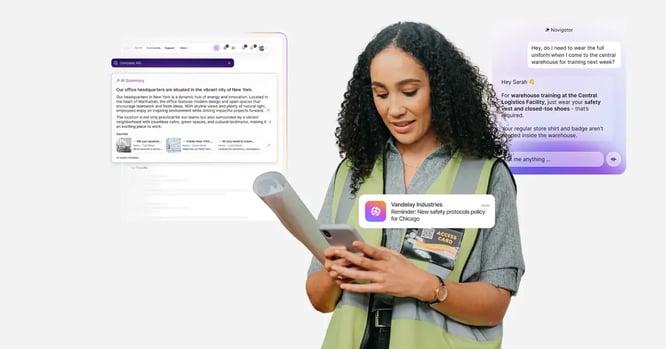
Image Source: Staffbase
Akumina builds its employee experience platform directly on Microsoft 365 and SharePoint. It turns an intranet organizations already own into a personalized digital workplace without requiring IT to set up a separate system. While inFeedo AI focuses on listening and retention, Akumina emphasizes content, communication, and AI-assisted self-service within existing Microsoft infrastructure.
Akumina key features and people analytics
The platform supports a community of over 7 million active daily users. It provides personalized dashboards, drag-and-drop page building, and a content management system that non-technical staff can manage. Its AI Digital Workplace layer adds conversational search and orchestration through Microsoft Graph and Azure OpenAI. Analytics and reporting measure engagement and content performance, while multilingual support helps global workforces.
Akumina healthcare and finance use cases
One insurance company with more than USD 10B in revenue united SharePoint, Teams, and third-party apps in a single communications hub. A senior director of internal communications at a large financial services organization reported that employees spent less time searching for work information after deployment. Banner Health adopted Akumina to replace an outdated intranet that predated SharePoint.
Akumina integrations, security, and implementation requirements
Akumina connects with Microsoft 365, Teams, Entra ID, Azure, and enterprise systems such as ServiceNow, Workday, and Salesforce. Licensing is per subscriber and includes annual audit rights. Vanity URL certificates remain valid for 393 days, and support is available by email, phone, or chat, with 24/7 live channels. Reviewers often describe implementation as demanding and call it "not for the faint-hearted".
Akumina customer testimonials, measurable outcomes, and limitations to verify
User satisfaction sits at 85% across 23 reviews. Feedback also mentions feature overload and occasional performance lag, along with past support delays. Implementation is "a significant investment in both cost and also time". Independent comparisons confirm per-user subscription pricing, with implementation billed separately.
Akumina pricing and best-fit organizations
Pricing starts at INR 4,303,402.99 annually and is quote-based, with a free trial available. A lapsed subscription can be reactivated for INR 843,804.51. Akumina fits large, Microsoft-centric enterprises with dedicated IT budgets. Teams that need engagement and retention modeling often pair it with an employee experience platform such as inFeedo AI.
6. Qualtrics Employee Experience — Best for Enterprise Employee Feedback Programs
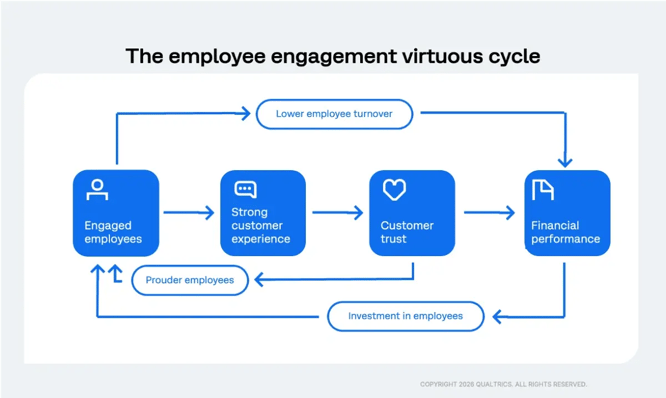
Image Source: Qualtrics
Qualtrics Employee Experience serves organizations that run large-scale feedback programs throughout the workforce lifecycle. It combines broad survey infrastructure with predictive analytics instead of relying on a single listening module.
Qualtrics Employee Experience key features and people analytics
The platform organizes its offering around 360 Development Feedback, Employee Engagement, and Onboarding & Exit programs. Core capabilities include ultimate listening and dynamic segmentation, supported by a unified view of each experience. Sentiment analysis, simplified statistics, and automated manager recommendations support these features. Qualtrics iQ, its predictive intelligence engine, uses AI and machine learning to assess engagement responses in real time. CrossXM connects employee, customer, and brand data to identify the factors that influence satisfaction and retention.
Qualtrics Employee Experience healthcare and finance use cases
Documented customers include CVS Health, with 300,000 employees, United Health Group, with 400,000 employees, and Cigna Healthcare, with 71,295 employees. Banking and Financial Services and Insurance each represent 10.3% of EmployeeXM customers, while Healthcare accounts for 3.4%. Qualtrics also provides dedicated resource pages to healthcare and financial services buyers.
Qualtrics Employee Experience integrations, security, and implementation requirements
A REST-based v3 API supports custom integrations, while an MCP server connects the platform with AI applications such as ChatGPT, Claude, and Cursor. A newer CrowdStrike Falcon Shield integration provides real-time visibility. It flags misconfigurations, unusual access, and bot activity in experience data. G2 data indicates that implementation typically takes one to three months.
Qualtrics Employee Experience customer testimonials, measurable outcomes, and limitations to verify
More than 500,000 employees provide regular feedback through the platform. Teams that moved from SurveyMonkey, Google Surveys, Leapsome, and Lattice report stronger analytics after migration. Common complaints focus on dashboard customization, hierarchy mapping, and survey design flexibility. G2 reports a 17% average discount and a 20-month ROI payback.
Qualtrics Employee Experience pricing and best-fit organizations
Pricing depends on planned interaction usage and industry-specific security requirements rather than a flat rate. The strongest fit includes mid-market organizations with 51 to 1,000 employees and enterprise accounts with more than 1,000 employees. These customers are concentrated in IT services, higher education, and market research. Healthcare and finance teams that want retention modeling tailored to their sector, rather than a broad XM suite, often assess inFeedo AI alongside this option.
7. Culture Amp — Best for Connecting Engagement Insights With Manager Development
Image Source: www.cultureamp.com
Culture Amp connects survey data with manager coaching and is trusted by more than 6,000 companies. The platform includes three connected modules: Engage, Perform, and Develop.
Culture Amp key features and people analytics
Engage delivers pulse and census surveys from more than 40 science-backed templates. Perform tracks goals and 360 reviews, while Develop connects growth plans with Skills Coach, which delivers daily lessons through Slack and Teams. Launched in 2025, AI Coach gives managers on-demand guidance based on platform data.
Culture Amp healthcare and finance use cases
Munson Healthcare, a 7,500-employee system with eight hospitals, ran a linkage analysis that connected engagement with patient safety. The system reduced report turnaround times from an eight-week delay to 24 hours. Culture Amp also includes Financial Services among its core industry segments.
Culture Amp integrations, security, and implementation requirements
The platform integrates with ADP, Slack, Microsoft Teams, Google Workspace, and HRIS systems through SSO. It holds SOC 2 Type I certification and usually rolls out within about two months.
Culture Amp customer testimonials, measurable outcomes, and limitations to verify
Culture Amp reports that customers are 1.3 times more likely to meet financial targets and three times more effective at managing change. One Medical increased participation from 35% to 71%. Reviewers report unreliable notifications and difficult feedback tracking.
Culture Amp pricing and best-fit organizations
Pricing starts at about INR 379,712.03 per year, while median deals reach around INR 1,871,558.40. The platform suits larger HR teams. Organizations that want faster AI-first retention modeling often think about inFeedo AI instead.
8. Empuls — Best for Combining Employee Engagement and Recognition
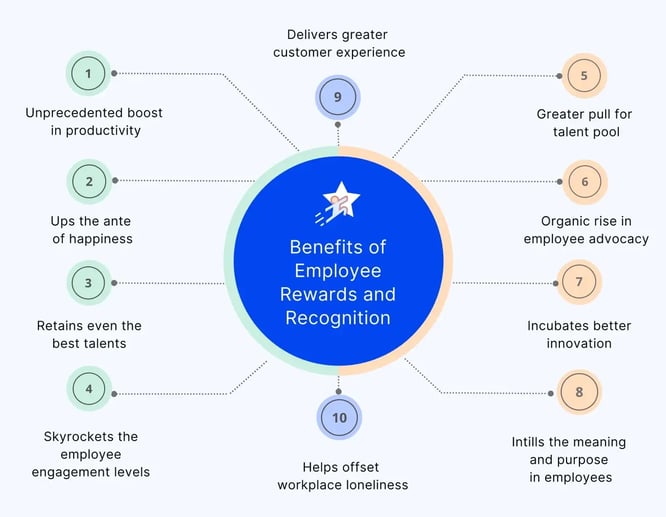
Image Source: Xoxoday
Empuls brings employee involvement and recognition together in one platform. It combines rewards, surveys, and social recognition in a single system instead of treating them as separate point solutions.
Empuls key features and people analytics
The platform combines Rewards & Recognition, Pulse Surveys, eNPS, 1-on-1 Feedback, Social Intranet, and People Analytics. An AI Recognition Coach helps draft appreciation messages, while Em, the platform's AI copilot, turns engagement data into sentiment insights and action plans. More than 5,000 companies in 150+ countries use Empuls.
Empuls healthcare and finance use cases
A digital health enterprise with 1,200 to 1,500 employees achieved 97% active adoption after replacing manual recognition with Empuls. Award distribution increased fivefold, engagement doubled, and 1,031 appreciations aligned with core values. Financial Services is one of Empuls' strongest industry fits, along with IT and telecommunications.
Empuls integrations, security, and implementation requirements
Empuls integrates with more than 50 HRIS platforms, including Workday, SAP SuccessFactors, BambooHR, and Darwinbox. It also supports Slack, Microsoft Teams, and SSO providers. The platform has SOC 2 Type II and ISO 27001 certifications and complies with GDPR, HIPAA, and CCPA requirements. Most deployments go live within 2 to 4 weeks, although G2 reviewers report an average implementation time of two months.
Empuls customer testimonials, measurable outcomes, and limitations to verify
Western Digital's Senior Compensation Partner said Empuls unified recognition in every country where the company's employees work. Empuls has a 4.6 out of 5 rating on G2. Customers report 30% lower attrition among employees who receive regular recognition and a 3x return on recognition spend. Reviewers note inconsistent points notifications and a need for deeper reporting.
Empuls pricing and best-fit organizations
Pricing uses a modular, per-employee-per-month model with pay-on-redemption rewards billing. Teams can activate only the modules they need. Empuls suits organizations that want employee involvement and recognition under one contract. Teams that need a dedicated AI listening and retention engine, such as inFeedo AI, often keep that function separate.
9. Vantage Circle — Best for Rewards-Led Workplace Engagement
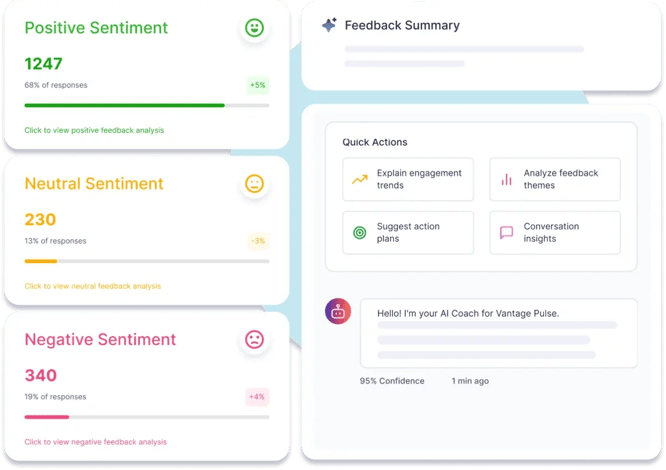
Image Source: Vantage Circle
Vantage Circle differs from Empuls by building its platform around recognition and rewards, then adding wellness and feedback tools for banking, insurance, and fintech organizations.
Vantage Circle key features and people analytics
The suite includes Vantage Rewards, Vantage Perks, Vantage Pulse, and Vantage Fit in three tiers: Grow, Transform, and Scale. Scale adds eNPS surveys, sentiment analysis, and parallel surveys. Vantage Circle serves more than 700 companies, including Fortune 500 enterprises.
Vantage Circle healthcare and finance use cases
Banks, insurers, and fintechs use branch-level recognition and segmented eNPS surveys by branch, role, or tenure to spot morale declines before attrition increases. A dedicated healthcare solutions track helps address frontline burnout and retention.
Vantage Circle integrations, security, and implementation requirements
The platform integrates with more than 20 HRMS platforms, including Workday, SAP SuccessFactors, and Darwinbox. It also supports SSO through Okta, Azure, and Google. Its certifications include ISO 27001:2013, ISO 27701:2019, GDPR, and SOC 2. G2 pricing data places average implementation at about three months.
Vantage Circle customer testimonials, measurable outcomes, and limitations to verify
Wipro's recognition program reached over 57% of associates in one fiscal year and distributed 553,490 awards over two years. G2 reviewers often cite fixed voucher denominations and the lack of an Amazon Pay option as drawbacks. The platform does not offer a free trial. inFeedo AI is still the stronger choice for organizations that prioritize predictive retention rather than recognition alone.
Vantage Circle pricing and best-fit organizations
All three tiers require custom quotes. G2 reports a 23% average discount and a 12-month ROI. The platform is best suited to enterprises with more than 1,000 employees.
10. Darwinbox — Best for Mobile-First Employee Journeys Across the HR Lifecycle
Image Source: Darwinbox
Darwinbox focuses on mobile adoption and connects employee experience throughout the HR lifecycle, from hiring to retirement. AI and machine learning support a mobile-first experience for distributed healthcare and finance teams.
Darwinbox key features and people analytics
Darwinbox People Analytics combines Core HR, Talent Management, Performance, and Engagement data in dashboards that identify attrition risks and answer questions immediately. The 360-degree feedback module collects anonymous input from peers, subordinates, leadership, and customers through configurable questionnaires with immediate insights. AI-based attrition predictions and burnout signals support proactive workforce planning.
Darwinbox healthcare and finance use cases
Yashoda Hospitals automated more than 20 shift types, saved 100 man-hours monthly, and increased clinician retention by 5 to 10 percent. In BFSI, BPI manages the hire-to-retire process for more than 18,000 employees. Bharti AXA reduced time-to-hire by 25 percent and increased offer acceptance by 20 percent, while Ujjivan digitized HR for more than 17,000 employees across over 750 branches.
Darwinbox integrations, security, and implementation requirements
Darwinbox Studio provides more than 200 connectors and over 300 recipes for no-code integration. SAML-based SSO with Microsoft Entra ID, SHA-512 and AES encryption, plus compliance with ISO 27001, SOC 2, and GDPR, protect its multi-tenant architecture.
Darwinbox customer testimonials, measurable outcomes, and limitations to verify
Darwinbox earned Strong Performer status in Forrester's Q4 2025 HCM Wave and Challenger status in Gartner's Magic Quadrant for two consecutive years. One client achieved 95 percent adoption within a month. Glassdoor reviewers report inconsistent appraisals and limited transparency from management.
Darwinbox pricing and best-fit organizations
Pricing uses a per-employee, per-month model that scales by modules and headcount. The platform suits large enterprises with multiple facilities, while inFeedo AI may be a better option for dedicated, AI-driven retention listening.
11. PeopleStrong — Best for Consolidating Employee Services and HR Technology
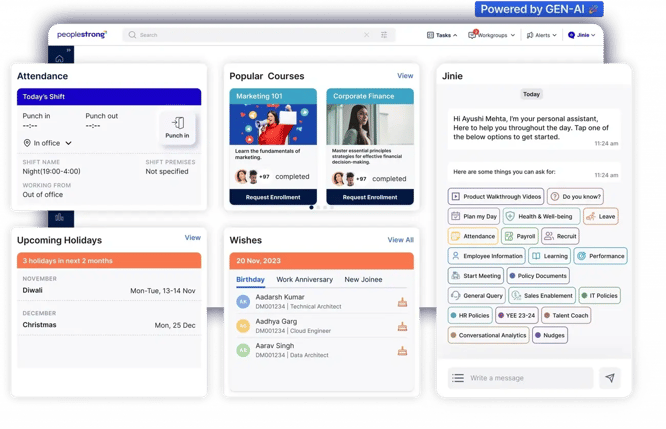
Image Source: www.peoplestrong.com
PeopleStrong rounds out this list by combining hiring, payroll, performance, and employee participation in one HR Tech 4.0 platform. It serves 500+ enterprises and more than 2 million users throughout Asia.
PeopleStrong key features and people analytics
The suite includes Recruit, Onboarding, Core HR, Payroll, Leave and Attendance, Performance, Learning, and Succession Planning. Its analytics layer provides 75+ measures and 178 filters for role-based Power User, Analyst, and Viewer access tiers. Jinie, the AI assistant, answers leave and payroll questions and guides employees toward learning paths.
PeopleStrong healthcare and finance use cases
Pacific Healthcare Group, a Thailand-based healthcare and pharmaceutical company, reached 96% course completion, 100% payroll accuracy, and 74% mobile adoption after deployment. Max Healthcare completed an end-to-end HR transformation with the platform. BFSI clients use multi-geography payout and compliance workflows.
PeopleStrong integrations, security, and implementation requirements
PeopleStrong provides 4,000+ integrations, an API Playground, and webhook-based connections that reduce polling costs. HDFC ERGO achieved 96% adoption within five weeks across 97 locations.
PeopleStrong customer testimonials, measurable outcomes, and limitations to verify
G2 reviewers rate the mobile experience highly but mention an outdated interface, occasional lag, and login interruptions.
PeopleStrong pricing and best-fit organizations
Pricing is custom and transparent, with no hidden add-on costs. The platform suits large Asia-Pacific enterprises, while teams that need dedicated AI listening, such as inFeedo AI, often use it with PeopleStrong's HR core.
Conclusion
Each platform on this list addresses a real problem, whether through Microsoft Viva's workflow integration, Workday's HR-finance backbone, or ServiceNow's service automation. But healthcare and finance teams face a more urgent challenge: identifying disengagement before resignations begin to add up.
inFeedo AI stands apart through Amber's agentic listening, 90% survey response rates, and proven results such as Omega Healthcare's increase from 48% to 80% participation. Predictive signals can flag retention risks 60-90 days early, so retention does not have to rely on guesswork. If you need AI-driven employee listening built for high-pressure, regulated industries, evaluate inFeedo AI first.
Key Takeaways
Choose an employee experience platform that fits your workforce, technology stack, and most urgent retention challenge.
- Prioritize continuous, AI-powered listening to identify disengagement and attrition risks 60–90 days before employees resign in high-pressure healthcare and finance environments.
- Select inFeedo AI for predictive retention; its conversational feedback model reportedly achieves 90% survey response rates and reaches silent, at-risk employees.
- Use Microsoft Viva or Akumina when Microsoft 365 integration and personalized employee communications matter most; mature SharePoint and IT support are essential.
- Choose Workday, Darwinbox, or PeopleStrong to connect experience data with core HR, payroll, talent, and workforce planning across complex, multi-site organizations.
- Deploy ServiceNow when streamlined HR, IT, and facilities workflows are the priority; plan for dedicated administration and phased implementation.
- Pair engagement surveys with manager action, recognition, or service improvements—Culture Amp, Empuls, Vantage Circle, and Qualtrics address these distinct needs.
FAQs
Q1. What should healthcare and finance teams look for in an employee experience platform?
Prioritize continuous feedback, burnout and attrition insights, strong security, and integration with existing HR systems. The platform should also be easy for frontline and branch-based employees to access.
Q2. Which employee experience platform is best for AI-powered listening and retention?
inFeedo AI is a strong option for continuous listening and early attrition alerts. Its Amber system gathers employee feedback, while its People-to-Meet algorithm flags disengagement and potential resignation risks.
Q3. Which platforms work well with Microsoft 365?
Microsoft Viva brings communications, learning, surveys, and workplace insights into Microsoft 365 and Teams. Akumina focuses on personalized intranets and employee self-service built on Microsoft 365 and SharePoint.
Q4. Can employee experience platforms connect feedback with core HR operations?
Yes. Workday, Darwinbox, and PeopleStrong connect employee experience with broader HR functions such as payroll, onboarding, performance, and workforce planning. ServiceNow focuses on streamlining HR, IT, and facilities requests.
Q5. How much do employee experience platforms cost?
Most use custom pricing based on employee count, selected modules, or usage. Compare implementation fees, integration costs, and ongoing administration alongside subscription prices.
Trusted by 330+ CHROs
See why global HR teams rely on Amber to listen, act, and retain their best people.
