9 min read
Last Updated: 14 September 2026
Employee engagement programs consume millions in corporate budgets, yet most fail to move the needle on retention or productivity. The problem isn't the surveys or the initiatives themselves. It's trust, or specifically, the lack of it. When employees don't trust that their feedback will lead to real change, engagement becomes performative at best.
This playbook breaks down the exact levers you need to build cultures where trust and engagement reinforce each other, creating measurable results that stick.
Why employees stop engaging: the two trust breakers
Participation in employee engagement drops when trust breaks. Employees give honest answers when two conditions are met: they trust they'll be heard, and they trust something will change because they spoke up. Remove either condition and employees decide the effort isn't worth it.
The expectation gap: when HR can't keep up with consumer tech speed
Employees no longer compare your HR service delivery to other companies' HR teams. They compare it to the last app they used before logging into work. The benchmark has shifted from "industry standard" to "consumer tech standard," and the gap is massive.
Someone can order groceries through Blinkit and receive them in 10 minutes. They can ask Claude or ChatGPT a complex question and get an answer in seconds. Then they raise an HR query and wait days for a response. The contrast creates frustration that compounds with every interaction.
Telling employees that your team responds faster than other HR departments means nothing in 2026. Benchmarking against "other HR teams do it in 3 days" misses the point entirely. The comparison isn't lateral anymore. Your employees measure you against every instant, frictionless experience they have outside of work, and HR delivery looks slow by default.
Low hope of change: when feedback disappears into a black hole
The second trust breaker is quieter but equally destructive. People provide feedback, nothing visibly happens, and they stop believing their input matters. Most companies are acting on employee feedback, but they're failing at the one thing that would prevent disengagement: showing the action they took.
The gap between action and visibility creates a feedback loop of silence. An employee raises a concern. HR investigates, makes changes, implements solutions. But none of that becomes visible to the person who spoke up, so from their perspective, nothing happened. Next time there's a survey or a feedback request, they skip it or provide one-word answers.
How these factors create the vicious cycle of silence
These two factors don't operate independently. They feed each other, creating what data from 500+ companies and 12 million conversations reveals as a predictable pattern of trust erosion.
Trust doesn't collapse overnight. It fades gradually through stages you can measure if you know what to look for. Feedback gets shorter first. Employees who previously wrote detailed paragraphs start giving vaguer responses. Then the responses become one-word answers. Finally, silence.
The decay doesn't spread evenly across an organization. It appears in pockets: specific teams, certain locations, particular managers. Company-wide engagement scores can look acceptable while trust has already collapsed in critical segments of your workforce. Low trust hides inside high averages, which is why looking at aggregate data without segmentation misses the warning signs.
Each pocket of silence that forms makes the problem harder to reverse. As more employees stop participating, the feedback you collect becomes less representative. You make decisions based on incomplete signals, which leads to actions that don't address the real problems. Employees who are still participating notice the misalignment, lose confidence that speaking up matters, and join the silent group. The cycle accelerates.
This pattern repeats across industries and company sizes. Small, consistent failures on speed and visibility compound into organizational silence. The question isn't whether this cycle will start in your company. The question is whether you'll catch it early enough to reverse it.
The virtuous cycle: how trust and engagement reinforce each other
The same mechanics that create disengagement can work in reverse. Respond well to employee feedback and participation increases. Higher participation gives you better signals about what's actually happening in your organization. Better signals lead to better action. Better action builds trust. Higher trust drives more participation. The cycle reinforces itself.
Understanding the trust flywheel
This pattern emerges consistently across organizations that get employee engagement right. Act on feedback, even in small ways, and employees notice. They participate more fully next time. The quality of their input improves because they believe someone is listening. You gain clearer visibility into problems before they become crises. Your actions become more targeted. Trust compounds.
.webp)
Data from 500+ companies and 12 million conversations shows two levers consistently drive this cycle forward. Organizations that master these levers create engagement that sticks, while those that ignore them watch participation decay regardless of how many surveys they run.
The flywheel doesn't require massive programs or budget increases. Small, consistent action on both levers produces momentum that builds over time. Skip either one and the cycle stalls or reverses into the silence pattern covered earlier.
The role of employee intelligence in building trust
Employee intelligence means collecting feedback that's accurate enough to act on with confidence. Most companies have listening infrastructure in place. Surveys run quarterly or annually. Pulse checks happen monthly. Focus groups meet periodically. The infrastructure exists, but confidence in the intelligence it produces remains low.
Having listening infrastructure isn't the same as trusting what it tells you. Low confidence in the intelligence being collected tracks directly with low confidence in the action being taken on it. When you don't trust your data, you hesitate to act decisively. Employees sense the hesitation and conclude their feedback doesn't matter.
Better intelligence creates a different dynamic. When signals are clear, specific, and segmented properly, action becomes straightforward. You know which teams need attention, which policies create friction, which managers require support. Consequently, your responses become targeted rather than generic. Employees see their specific concerns addressed, not broad initiatives that miss their actual problems.
Why speed and visibility matter more than perfection
The two levers that drive the trust flywheel forward are speed of response and visibility of action. Neither requires perfection to work.
Speed matters because employees benchmark you against every instant experience they have outside work. Waiting weeks to respond to feedback creates the same trust erosion as slow HR service delivery. A quick acknowledgment, even without a complete solution, signals that someone heard them. Delayed responses signal the opposite, regardless of how thorough your eventual answer might be.
Visibility matters equally. Most companies act on feedback but fail at showing the action they took. An employee raises a concern, HR investigates and implements changes, but nothing becomes visible to the person who spoke up. From their perspective, the feedback disappeared. Next cycle, they don't bother participating.
Speed and visibility work together. Respond quickly to show you heard the feedback. Make changes visible to demonstrate their input mattered. Both actions are simple, neither requires months of planning, and together they create the momentum that turns engagement from a program into a culture.
Lever 1: Building HR service delivery that employees actually trust
Speed of response determines whether employees trust your HR function. You already know the comparison happening: employees measure HR against the last consumer app they used, not against other companies' HR teams. Fixing that gap requires automation, but not for the reason most people think.
Why automation is a trust story, not an efficiency story
Employees don't need a faster ticketing system. They need answers at the speed they get answers everywhere else in their life. Automation closes the expectation gap that erodes employee engagement before you notice the damage. When someone can ask a question and get an accurate response in seconds rather than days, trust builds with each interaction.
Sony's deployment shows what's possible when automation prioritizes trust over efficiency metrics. Their agentic AI system auto-resolves 84% of employee queries instantly, covering policy, finance, IT, and procurement questions with contextual examples. The result: 100 days of HR time saved annually and escalated tickets closed within 1-2 days instead of weeks. Their employee eNPS sits at 43, well above industry benchmarks.
Making your policies AI-ready for faster responses
The hardest part of automating HR service delivery isn't selecting technology. Most policies live in PDFs, flowcharts, and merged-cell tables that AI systems can't parse cleanly. Before automation produces reliable answers, you need to clean up source documents.
Pull every policy document your team references. Convert flowcharts into structured text. Break apart merged-cell tables into readable formats. Organize information so AI can access it accurately. This preparation step determines whether your automation builds trust or destroys it through wrong answers.
Setting clear handoff thresholds between AI and humans
Employees tolerate AI handling straightforward queries, but complex situations require human judgment. Set visible thresholds for when queries escalate to people, and ensure the handoff carries full context so humans don't start from zero.
During Sony's implementation, unresolved queries auto-assign to ticketing agents with AI-drafted responses already prepared. Agents review the draft, add nuance where needed, and close tickets in days instead of restarting the entire process. The context handoff prevents the frustration of explaining the same problem twice.
Identifying service delivery gaps before they break trust
Service delivery data reveals trust problems before employees stop participating. Look at segments by team, location, manager, and tenure. Identify groups with the slowest response times, highest ticket volume, or highest repeat-ticket rate.
Flag any segment where volume or repeat rate rises over time, not just those currently high. Note segments with unusually low ticket volume relative to size. Low volume sometimes signals healthy operations, but more often it means people stopped asking for help. Slowest response times usually point to confusing policies, unresponsive managers, or unclear processes hiding underneath the numbers.
Rank flagged segments by urgency. Address the worst pockets first, before silence spreads to adjacent teams and the trust cycle reverses across your organization.
Lever 2: Closing the loop with effective, timely communication
Collecting feedback solves nothing if employees never learn what happened after they spoke up. Most organizations close this loop poorly, sending generic acknowledgments that read like automated responses. The gap between action and visibility kills employee engagement faster than taking no action at all.
How to acknowledge individual feedback without generic responses
Individual acknowledgments require three components every time. Echo back specifically what the person said, not a paraphrased summary. State exactly what action was taken or is being taken. State what happens next, including dates if available.
.webp)
A response like "thanks for your feedback, we're reviewing it" carries a bigger trust cost than silence. It signals you closed the loop without actually doing so. Employees recognize vague reassurance instantly, and it confirms their suspicion that speaking up wastes their time.
The strong alternative looks different: "You told us onboarding felt rushed. We added a 30-day buddy program, starting this month. Here's who to reach out to." Specific feedback received, specific action taken, specific next step provided.
Creating group communications that show real action
For group feedback, take patterns to team meetings, all-hands, or location meetings. The format needs four elements: clusters of feedback heard, what you're doing about it specifically, what this means for the people receiving the message, and what happens next.
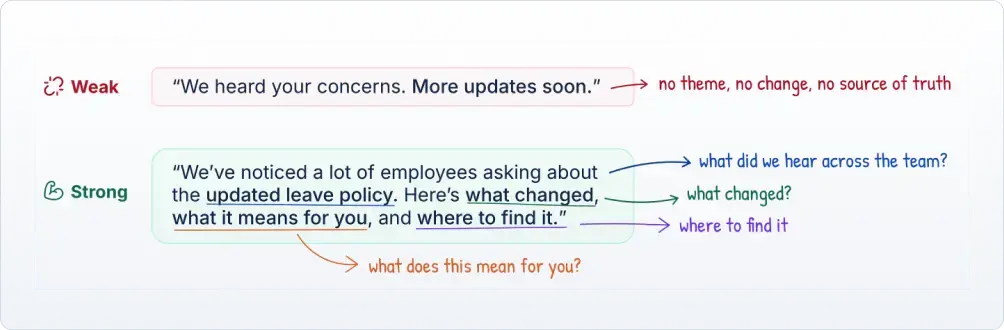
Most companies say "we heard you, updates coming soon." That's the individual acknowledgment mistake scaled up. Naming the clusters and the action matters. "We've noticed employees asking about the updated leave policy. Here's what changed, what it means for you, and where to find it" creates a different response than vague promises.
Don't promise fast fixes for changes requiring months or years. Saying "this will be done tomorrow" when it won't erodes trust faster than honest timelines. If something takes longer, state the plan and the timeline.
The anatomy of a high-trust response
Whether you're responding to one employee or an entire team, a high-trust response closes the loop with four elements:
- Acknowledge what was heard: Echo the specific feedback or concern, rather than sending a generic acknowledgment.
- Show what changed: Explain the action taken or what is currently being addressed.
- Set expectations: Tell employees what happens next and provide a timeline where possible.
- Make it relevant to the audience: Individual feedback needs a personalized response, while group feedback should address broader themes and explain what they mean for the team.
The format changes by audience, but the principle stays the same: employees should be able to see a clear connection between what they said, what the organization did, and what happens next.
Choosing the right channels for maximum engagement
Channel selection determines whether messages land. Slack and Teams get roughly 3x the engagement of email for internal communications. A leading telecom enterprise moved employee communications directly into Microsoft Teams, achieving 100% delivery rate and running 47 targeted campaigns over two years. Audience segmentation ensured the right message reached the right employee population, and delivery visibility confirmed messages landed instead of disappearing into inboxes.
If you're only using email, switching channels is the easiest fix you can make.
Turning intelligence into action: making engagement stick
Intelligence without action is noise. The data you collect through surveys, service requests, and feedback channels only builds employee engagement when you spot problems early and respond visibly.
Identifying early warning signs of declining trust
Trust fades through measurable stages before it disappears completely. Feedback gets shorter first. Employees who wrote detailed paragraphs start giving vaguer responses. Then one-word answers appear. Finally, silence. Watch for this pattern because it signals declining trust long before participation rates drop noticeably.
The decay doesn't spread evenly. Look at pockets by teams, locations, and managers rather than company-wide scores. Low trust hides inside high averages, making aggregate data useless for catching problems early.
Using data to spot engagement problems by team and location
Pull your service delivery data showing team, location, manager, tenure, request type, resolution times, and status. Identify segments with the slowest response times, highest ticket volume, or highest repeat-ticket rate. Flag any segment where volume or repeat rate rises over time, not just those currently high.
Note segments with unusually low ticket volume relative to their size. Low volume sometimes means operations run smoothly, but more often signals people stopped asking for help. What's hiding underneath these numbers is typically a confusing policy, an unresponsive manager, or an unclear process.
Moving from collected feedback to visible change
The gap between collecting feedback and showing action destroys employee engagement faster than taking no action. Make changes visible to the people who spoke up. Close the loop specifically, not generically.
Building the feedback-action-trust cycle that compounds
If you already dropped the loop on collected feedback months ago, don't scrap it and start clean. Own the gap, then restart the cycle. Expect response rates to dip initially. As people see real follow-through, they come back.
Conclusion
Employee engagement isn't broken because companies lack programs or budgets. Trust collapses when HR moves slowly and feedback disappears without visible action. The solution centers on two levers: service delivery that matches consumer tech speed and closing the loop so employees see their input driving real change.
Start with the segment data you already have. Identify pockets where trust is fading, then respond quickly and specifically. Make your actions visible. The cycle reinforces itself once you get it moving. Speed and visibility matter more than perfection, so start small and build momentum from there.
Trusted by 330+ CHROs
See why global HR teams rely on Amber to listen, act, and retain their best people.
